Showing posts with label Planning. Show all posts

Thursday, April 16, 2015

Reflections on an Awesome Week!

Last week was an awesome week!  If you were to ask me why, I don't think that I could name just one thing.  Instead, I would have to say that it was a combination of many things, all of which were WBT related.  I would like to share with you my list of what made last week one of my favorite teaching weeks of the year.

1.  Our focus skill this week in both reading and writing was possessive nouns.  In the past this has always been a challenge to teach and not something that I looked forward to.  This year, however, was very different.  Not only was it a lot of fun to teach, but my students all quickly and easily caught on to how to use apostrophes to make nouns plural.  I firmly believe that this was mainly due to the WBT way of introducing possessive nouns:  splitters and jammers.  

A splitter is the WBT name for an apostrophe "s" that is used with a singular noun or an irregular plural noun, such as children.  I explained to the class that the splitter (the apostrophe) splits the owner from the "s".  I called the "s" the "badge of ownership" and used the gesture of pointing a thumb on each hand to the front of my shirt.  I would box the noun to show the owner and then talk about how the splitter split the owner and the badge of ownership.  During writing we played the complexor Game. (More information on the Complexor game can be found in other blog posts or on the WBT website under free downloads/The Writing Game.)This gave students many opportunities to orally write sentences with apostrophe s's.  They then wrote the sentences that they had created in their writing notebooks.

A jammer is an apostrophe that follows a plural noun which ends in "s".  I explained to my students that the jammer jams the "s" into the noun, making it plural.  The jammer becomes the "badge of ownership".  The concept of the "badge of ownership really helped my kids to remember to write the apostrophe after the "s".  The kids simply learned that there is always an apostrophe after a jammer, because that is how you show ownership.  We also played the Complexor game with plural possessives and wrote the sentences created in our writing notebooks.

After studying splitters and jammers separately, we combined them together and students had to determine when to use a splitter and when to use a jammer.  This is what the board looked like for that lesson:
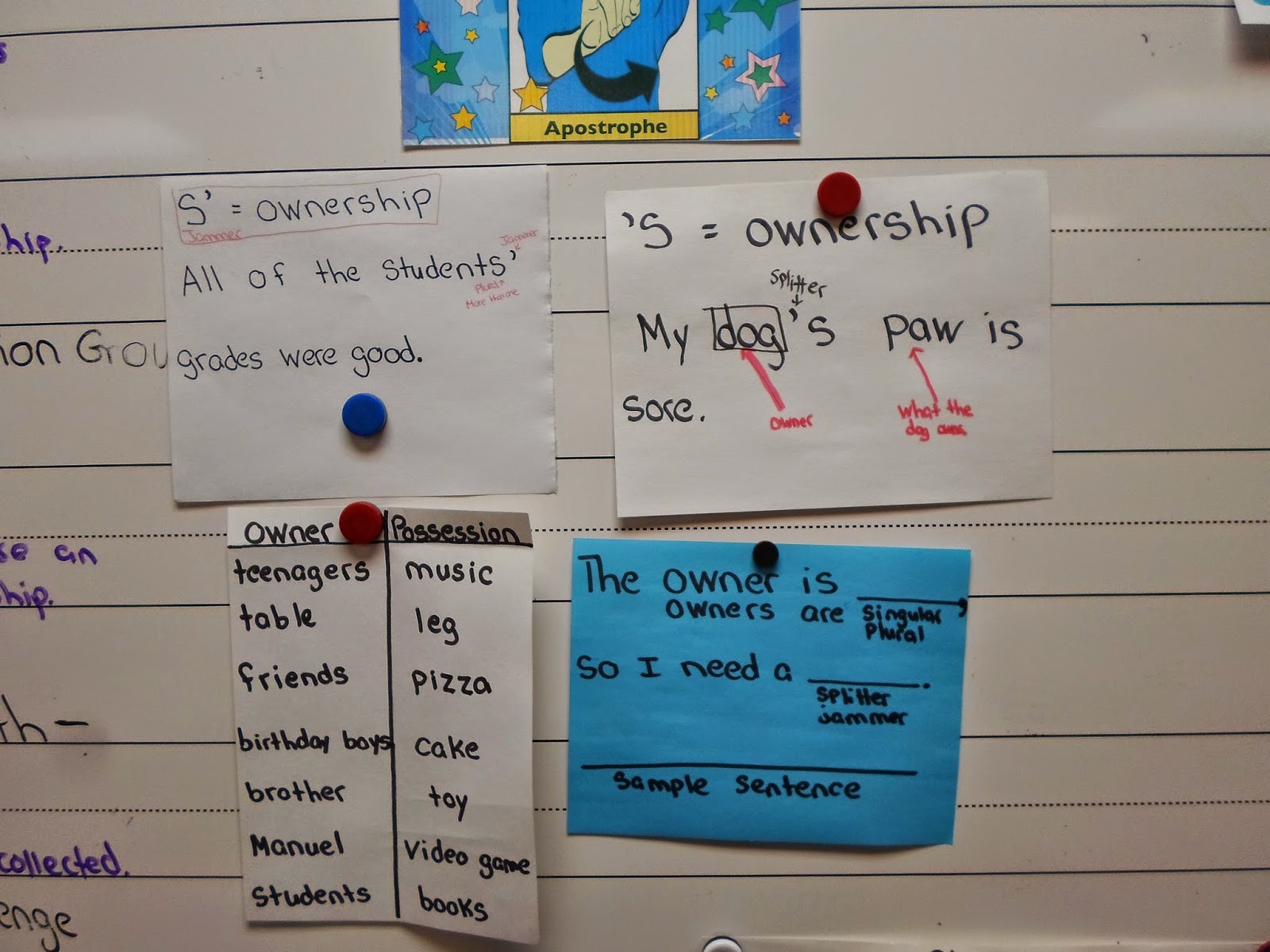
                                                             

You will notice the apostrophe Brainie at the top of the board.  We obviously focused on this Brainie for the entire week.  Under that you will see two anchor charts that I created, one for singular possessives and one for plural possessives.  On the day of this lesson I added the list of owners and possessions, as well as the sentence frames.  Using Teach Okay and High Five Switch, students took turns sharing with their partners whether or not the owner was singular or plural and whether they needed to use a splitter or a jammer.  They then had to create a sentence using the owner and the possession, in which they used the apostrophe Brainie.  After students had time to work on this with their partners, they shared with the class using High Five Teach.  I was amazed at how well they had caught on.  Even my lowest students were able to explain when to use a splitter and when to use a jammer.  I will never teach possessive nouns any other way,


2.  Our phonics skill for the week was creating plurals with nouns that end in "s".  In the past I have always taught this in the form of a year.  This fit perfectly with WBT.  Students still learned the cheer, but they learned it using Mirror Words and Practiced it using Teach Okay.  We call it the "Five Finger Rule" cheer.  The cheer goes like this:  If a word ends in s, x, z, sh, ch (hold up one finger for each), you gotta (bend left arm in front of chest with had in a fist.) add (Do the same with right arm.) "es" (Very slightly raise fists on both hands.), yes!  (Jump in the air and bring bent arms out straight.)  The kids have so much fun doing this cheer, and by the end of the week everyone knows when to use an "es" to make a word plural.

3.  We did two Genius Ladders last week that were both very challenging, but the students did a great job on them.  They both focused on possessive nouns, but on one there was an apostrophe "s", and on the other there was an "s" apostrophe.  On both I included a dependent clause telling when.  This is our newest extender.  We have been working on it for about three weeks.  Both ladders were very challenging.  The sentences were quite long and there were a lot of Brainies in them, but the kids did a great job!  I was very proud of them.

4.  For red/green writing I asked the students to write a five paragraph essay on what they did over spring break.  I am happy to report that fifteen out of my seventeen students can now successfully write  a five paragraph essay.  My biggest celebration is that one of my two lowest students, a special ed. child who began the year as a non-reader, was able to write for the very first time (with a little assistance) his very first five paragraph essay.  The class celebrated with him as he earned a Super Improver Star.  I also had a number of students use possessive nouns correctly in their writing.  They were all quick to point this out to me, because they were all looking for a Super Improver Star.  I am happy to say that they each earned one.

5.  This week I introduced students to the Brain Tree.  If you are unfamiliar with the Brain Tree, that is because it is the newest WBT technique, hot off the presses just a few weeks ago.  The concept is simple.  Students score themselves from a 1-5 on different WBT techniques that they are using in the classroom.  An analogy is made to an Oak tree.  A one is an acorn, all the way up to a five, which is a mighty towering oak tree with many acorns.  Points are considered leaves, and each week scores are added together to get a total number of leaves for the week.  The goal is for students to beat their previous week's score.  At our school we are having a little friendly competition among participating classes.  Everyone who is doing the Brain Tree has placed one on their door, with their scores.  This will allow other classes to see these scores and try to beat them.  

This was our first week using the Brain Tree, so I wasn't sure how my students would respond to it or how they would do with scoring themselves.  I was very pleasantly surprised.  They caught on to the concept very quickly, and when it came time to give themselves a score, I was amazed at how honest and accurate they were.  The Brain Tree is definitely a great tool  to motivate students.  I am excited to see how they progress each week.  They have set a goal for themselves to have a perfect score (a five in each area) by the end of the year.  That sounds like teacher heaven to me.  We'll see how it goes.  

If you are interested in using the Brain Tree in your room, I have inserted a link with directions and the chart.  I blew my chart up using the poster maker and added pictures of the five different stages in an Oak Tree's development.  Here is the link:


6.  One of my students came up with an idea that we tried, and it has really worked well.  Whenever I ask my students to share with each other using either High Five Teach or Uh/Oh Switch, the student who is sharing stands.  This works really well when the students are at their seats, but when they are seated on the floor in the meeting area, I have told my students not to stand.  One day during the week we were in the meeting area about to use High Five Teach, when one of my students raised her hand and suggested that the student sharing do so while on his/her knees.  I wasn't sure how this would work, but I said that we would give it a try.  It has been great.  The students love it, and it allows them to move a little, even if it is just a change of position, while they are on the floor.


7.  We have been working really hard in reading on two things:  paraphrasing and remembering detail adders.  I have spoken to my students about the need to stick the detail adders in their minds and have used the analogy of velcro to help students get that visual image.  We have also talked about the importance of sticking the first and the last detail adder because if we do that, the ones in the middle are easier for our brains to remember.  This lends itself to paraphrasing because if students are able to stick the details in their brains, they will easily be able to paraphrase what they are reading.  We have been practicing this in reading groups, but I decided to see how it would work as part of the Crazy Professor Game.  (This is another WBT game that can be found on the WBT website under free downloads.)  I gave students a fiction passage entitled The Difficult Assignment.  We read the first paragraph using Mirror Words.  I then asked the students to read the paragraph on their own using their Brainies and their gestures, but I also gave them the goal of making sure that they stuck the first and the last detail adders in their minds, to help them with the middle ones.  We even started calling this a detail adder sandwich.  Students then used Uh Oh Switch to paraphrase that first paragraph with their partners.  We repeated this process with each paragraph.  I am happy to report that even my lowest students were able to paraphrase.  Next time we are going to try this with a non-fiction text.


So, there you have it.  Those are the highlights of the week.  I hope that the ideas and experiences that I have shared in this blog will inspire you.  Here's to more week's just like this one!

Thursday, March 26, 2015

Planning

It is really hard to believe that next week is spring break and that I am right at a couple of months short of completing my first full year as a Whole Brain Teacher.  It has been an amazing year!  I have learned so much as an WBT intern.  I am so grateful to Nancy, my mentor, and to Coach B. for all of their help and encouragement.  Over the course of this school year I have written about a variety of techniques, skills, and strategies that you would find in a WBT classroom.  For this blog I have decided to answer a question that a lot of people have asked me this year:  Do you find that planning is easier or harder when you are doing Whole Brain Teaching?

The answer to that question is simple.  It is so much easier!  O.k, to be honest, it was harder in the beginning, but that was because everything was so new to me and I had so much to learn.  It took time to figure out how all of the pieces fit together.  Now, I can honestly say that I spend a lot less time planning than I used to.  I think that this is mainly due to the fact that the structures (The five step lesson, Power pics, The Genius Ladder, Teach/Okay, Mirrors, Red/Green Writing, Brainies,  the use of Sentence Frames etc.) are already there.   I just have to plug my lessons into them.  I have found that with so many tools, I can easily weave instruction of a new concept into multiple parts of my day.

A perfect example of this is a unit that we just completed last week.  Our class spent two weeks learning about Point of View and Dialogue.  The first week I focused on point of view.  The five step lesson format made planning very easy.  I began by creating a Power Pic for point of view.  Deciding on my question and answer was very important, because I knew that it was these two things that would guide my instruction.  Below is my Power Pic:


Question:  What is point of view?
Answer:  Point of view is who is telling the story:  first person, a character; second or third person, the author.
Gestures:  Shrugging shoulders and then holding up one finger at a time for each of the three persons.

I knew that each day that week I would begin with my question and answer.  When thinking about how to expand my lesson, my first step was to create a sentence frame.  I use sentence frames on a regular basis.  They provide a support and structure for my students, especially my ELL students, as they share during Teach Okays and Call-Outs.  I chose the following frame:  This story is being told from ________________.  I know this because ________________.  When planning any lesson I automatically include opportunities for students to prove their answers using a "because clapper".

This led to the question, "What do I expect my students to use for proof?"  I quickly decided to use the WBT concept of "Power Words".  I created an anchor chart with a tree map.  On the tree map I placed my power words for first second and third person, along with my sentence frame.  Below is a picture of it.  This anchor chart stayed in the front of my room and became a reference for my students during the entire unit.  Below is a picture of it.

                   
Once this was done, the rest was very easy.  The main way that I taught the concept was to read short paragraphs and using Teach/Okay ask the students to share from what point of view the text was being told and how they knew.  I would remind them to use the sentence frames on the anchor chart.  For proof they would say things like, "I know this because I heard the Power Words he, she, and their.  For a couple of days I read the same scenarios, but from different points of view.  Students would use these same sentence frames to discover the point of view that the books they were reading were being written from.  At the end of independent reading time, students would first share with their partners using Teach/Okay and then with the class using Call-outs.

The last step of the five step lesson plan is critical thinking.  This is usually done through writing.  During Red/Green writing I gave my students a short story about a cat named Cupcake who ran away from a campground and walked 150 miles to get back home.  The story was told from third person.  I asked my students to rewrite it from first person, the point of view of Cupcake.  We did some oral writing practice first, and then they began.  The students did a really nice job.  Below is one of their stories.


During this first week, something happened that I was hoping for.  I shared a text with quotation marks.  The character speaking used the word "I'.  Some of my students immediately thought that this had to be first person.  This led to the introduction of quotation marks.  It was a perfect lead-in.  In the past I had always struggled with the best way to teach quotes to second graders, but this year it was easy.  I began with the Quotation Mark Brainie.  My students were familiar with it, because I had previously pointed quotes out to them in text and they had used the Braine, but they really did not understand this Brainie.  I decided that the Brainie would serve in a way as my Power Pic.  This led to me deciding upon the following question and answer:

Question:  What are quotation marks?
Answer:  Quotation marks are talking marks.  They go around the exact words that come out of a character's mouth.
Gesture:  The gesture for the quotation mark Brainie.

Over the course of the week I gave students short stories with lots of quotation marks.  We would do what I called the one minute drill.  They had one minute to underline all of the quotes.  (Of course, I first demonstrated how to do this.)  They then had to read the passage with their partner using their gestures and Brainies, with an emphasis on making sure that the quotes were done properly.  (This had also been modeled numerous times.)  I then asked students to tell their partners (Teach/Okay) the point of view that the story was being told from (Students used the sentence frames on the anchor chart.) and then called on a student to share using a Call-Out.  We then focused on the quotes.  Using High Five Switch, the students had to take turns reading the quotes in order and telling who said it and how they knew.  As they shared, they were expected to use their Brainies, especially quotation marks.  I emphasized the comma and using a capital Brainie for the first word at the beginning of a sentence inside of the quotation marks.  Of course I provide them with the following sentence frame:  ______________ said __________________.  I know this because ___________________.  For their proof they usually said something like, "I know this because it said _______ said after the quotation marks."

As I did with point of view, I asked the students to find quotes in the books that they were reading and to share at the end of independent reading time, using the sentence frames that I had provided.

They were doing so well with all of this, that I decided to take quotation marks to a Genius Ladder and see how well they did at it.  Below is the Genius Ladder that I used.


The students had a really good time with the simple sentence that I chose.  At the Genius level students were asked to write a conversation with themselves and their mom.  Most of my students were correctly using quotes, not forgetting the comma before or after the quote, and were capitalizing the first word inside the quotation marks.  This can be attributed to all of the oral writing that they had been doing with quotation marks.  I was really impressed with how well many of them did at changing paragraphs when they changed speakers.  My students were already very familiar with paragraph form and the indent Brainie, so this wasn't that difficult for them.  You may have noticed that at the extender level I introduced my students to the dependent clause.  This is another Brainie that we had not previously talked about.  Prior to this time, they were not ready for it.  They still needed more work on it.  It will definitely be the focus of our next few Genius Ladders, but they are beginning to catch on.  It just amazes me the caliber of writing that you can get from second graders and what they are actually capable of understanding.  Prior to finding a Whole Brain Teaching I would have never imagined that my students would be writing conversations so effortlessly with quotation marks and in paragraph form, nor would I have believed that they would be able to correctly write complex sentences with dependent clauses.

As a side note I wanted to point out that towards the end of this time we began an explanatory text unit in writing.  Right away one of my students raised her hand and said, "We are going to be writing from second person."  It was one of those moments when all I could do was say a quick prayer in my head, thinking God for Whole Brain Teaching.

I hope that you have found this look into my planning process helpful.  Happy teaching!