Showing posts with label Genius Ladder. Show all posts

Saturday, June 6, 2015

Good-byes

I love teaching, but I hate having to say good-bye to my students on the last day of school.  Every year was tough, but this year was particularly tough.  I had this amazing group of students - my inaugural WBT class - whom I did not want to leave.  We went through the year together and they were my willing guinea pigs.  We laughed together, learned together, and had so much fun together.  I am not sure who loved Whole Brain Teaching the most - my students or myself.

As I reflect back on this school year, there are so many things that I learned.  I can't even begin to tell you how many ah, ha moments I had.  It was a journey that was a lot of hard work, but I will never regret taking it.  I have grown so much as a teacher this past year.  The highlight of the year was becoming a certified Whole Brain instructor.  I am looking forward to the future and am excited about being able to share what I have learned with others.

Over the summer I will begin looking ahead to next year.  I am looking forward to next year in a whole different way.  Last year there was the excitement of beginning something new and the fun of trying to learn and figure everything - and I do mean everything - out.  This upcoming year I am excited about knowing what I am doing and not having to figure everything out.  

Many people have asked me what I am going to change for next year, and my answer is not really a lot.  Yes, I will make a few minor tweaks, and because I know what I am doing, my timeline for some things will change.  However, all of the strategies, techniques, and games that I have used this year will remain.  My motto is "Why mess with perfection?"  After all, in my book WBT is about as close to teaching perfection as you can get.

Another question that I have been asked is what my favorite parts of WBT are.  That is a tough one, because the real answer is everything.  However, as a challenge, I posed the following question to myself:  If you could only implement ten components of WBT, what would those ten components be?  This led to my list of ten WBT must haves.  Here it is:

1.  The Super Improver Wall

2.  Mirror Words

3.  Teach Okay

4.  The Brainies

5.  The Genius Ladder

6.  Red/Green Writing

7.  Puzzlers and Complexors

8.  The Scoreboard

9.  Class Yes

10.  The Rules

I am just thankful that I am not actually limited to only ten. If, however, you are just starting out in WBT and are looking for a place to begin without getting too overwhelmed, these are the ten that I would definitely start with.  My suggestion would be to  master these ten, and then branch out and continue to explore the wonderful world of WBT.  You can find more information on all of these topics right here on my blog, or you can go to WholeBrainTeaching.com for free downloads and webcasts on each of these topics.

I hope that all of you have a wonderful and restful summer.  Maybe I will see you at the National Conference in Louisiana.  Have a great vacation!!! 

Tuesday, May 26, 2015

WBT Freebies

If you are just getting started in WBT, I would like to share would you a wealth of free teaching resources that you may have not yet discovered.  I am speaking about all of the wonderfully amazing free downloads that are available on the WBT website.  They will make you ask yourself how you had ever taught without them and why you had not found them sooner.  At least those were the questions that I asked myself when I stumbled across these goodies.

Let's begin with where to find them.  First, you need to go to the WBT website.  The address for this site is www.wholebrainteaching.com.  The next step is to register on the site.  The good new is that it doesn't cost anything to register.  You just need to create a user name and password.  Once you've done this, log into the site and all of the downloads are yours.  There is just one small caveat to this.  The only thing that Christ Biffle (the founder of WBT) and the board members ask is that you share these resources with at least ten of your colleagues.  WBT is a grass roots educational reform movement, and by you sharing what you have found, you will be sharing a little bit of teacher heaven with others.  To get to the freee downloads, scroll down the right side of your screen.  Directly beneath WBT certification, you will find the tab for free downloads.  Click on it, and three pages of unbelievable downloads are waiting for you to access them.

When I first started learning about Whole Brain Teaching, the downloads were one of the very first things that I discovered.  The problem was that there were so many of them, and I had no idea what any of the names meant.  Whole Brain Teaching definitely has a language of its own, so to me it was like reading Greek.  Therefore, I spent a lot of time downloading and reading, trying to find the ones most applicable to me and the ones that I wanted to implement in my classroom right away.  It was very time consuming, and it would have been nice to have had someone to guide me through the process, suggesting which downloads would be most appropriate for my grade level and which ones I would want to look at right away.

I am hoping that in this blog post I can be that guide for you.  I'd like to begin with my top three picks for you, regardless of your grade level.  These three downloads all involve writing and will work in synergy with one another to make your writing program a complete success.

1.  The Brainy Game:  I love the Brainy Game because it will teach you how to do all of the oral writing gestures that are used all day long in a WBT classroom.  It will also provide you with beautiful color pictures that you can print and display in your classroom.  You will find that the Bainies will quickly become a favorite of both you and your students.

2.  The Writing Game:  I love the writing game!  What it does is take writing and break it down into its smallest components.  These components are then taught to the students one at a time in a game format known as complexors.  The concept behind it is really simple.  You wouldn't take someone new to tennis and put them on the court to play by simply demonstrating each shot.  A good tennis coach would break each shot down and teach his student one step at a time how to make that shot.  Practice alone does not make one a better tennis player.  You have to practice the correct way.  Writing is no different.  As educators we are good about giving students plenty of opportunities to practice their writing.  Unfortunately, what they are practicing is often incorrect.  By using complexors, you are providing your students with a fun way to practice the smallest components of writing correctly.  The complexors are then used by the students within writing puzzles.  the puzzles provide a structure for writing.  It is without a doubt the best way that I have ever found to teach writing.

3.The Genius Ladder:  I love the Genius Ladder.  It has made a huge difference in helping my students understand how to write a complex sentence correctly, as well as how to write a paragraph with a topic sentence, detail adders, and a concluder.  To learn more about the genius ladder, please see my separate post on the subject,

Next I would recommend taking a look at all of the Super Speed Games.  These games are so much fun for the students, because they are all about beating previous scores and previous times.  This is something that as teachers we know all students love to do.  They are learning, and they don't even realize it.  I have divided the Super Speed Games into two groups.  The first are games that are appropriate for all grade levels.  The second are for beginning readers/learners.

All Levels

1.  Electronic Super Speed Grammar:  Hands down you will find no better way to teach students the parts of speech, as well as to work on what a complete sentence is.  It is one of my favorite downloads.

2.  Electronic Super Speed 1,000:  This is a reading game designed to help students learn the 1,000 most frequently used words in the English Language.

3.  Electronic Super Speed Math:  The most successful way I have ever found to help students master there basic addition, subtraction, and multiplication facts.

4.Smooth Bumpy Planet:  I have to be honest.  This is a game that I have not used yet with the whole class.  I remember reading about it last summer and thinking how awesome it would be to use when teaching number concepts like skip counting, place value, and even basic addition and subtraction facts.  Until recently, however, I had forgotten about it.  Just recently I was looking at it again and kicking myself for not using it this year when I taught my students skip counting, place value, and how to count to 1,000.  I will be definitely be using it on a regular basis next year.  I have already laminated the number charts.

For Beginning Readers

1.  Electronic Super Speed Rhyme:  The focus of this game is word families.

2.  Electronic Super Speed 100:  In this game students learn the first 100 sight words.  Let me just point out that this game is great for special education students who need many, many repetitions of a word before they can own it.

3.  Super Speed Letters and Phonics:  This game will teach students their letters and sounds.

4.  Super Speed Numbers:  This game will help students learn how to count to 100.

5.  Biffytoons:  This is a great way to introduce beginning readers to basic sight words.


In addition to the above downloads, I would also highly recommend for kindergarten through third grade teachers the language arts and math power pics.  These can be downloaded by subject and grade level.  They are visuals with gestures and definitions that accompany math and language arts standards.  They are used as part of the WBT five step lesson.  (Please see my posts on the five step lesson.)

Finally, I would recommend Mind Soccer for everyone.  Mind Soccer is the WBT review game that is usually played on Friday afternoons.  It is a lot of fun, and the students look forward to playing it every week.

There are many other downloads available that you will also want to check out, but what I have given you is a good place to start.  I hope that you have found me to be a good guide through the world of WBT free downloads.  Happy teaching WBT style!


Thursday, May 21, 2015

Red/Green Writing Across the Curriculum

I have been using red/green writing since the first day of school.  I love it!  If you are not familiar with what it is, here is a brief overview:   To get started all you need is a green and a red pen.  Assign students a ten minute quick write.  Make the topic open ended so that students can not claim to be finished.  Announce the focus skill/s that you will be looking for.  At the beginning of the year start with neatness.  Then, every one or two weeks, add an additional skill that you will be looking for.  Students are responsible for both the previous skills and the new one.  As students are writing walk around with your pens.  Place a green dot next to an example of something the student did right.  For example, a word that is written very neatly, a capital at the beginning of a sentence, or an end mark used correctly.  Place a red dot next to an error, but do not say anything.  You want the student to correct the error on his/her own.  I found that my students knew exactly what they had done wrong as soon as I made the mark, because they knew which focus skill/s I was checking for.  My class hated getting red marks.  As a result, they were much more careful when they wrote.  They would get so excited when they had all green marks on their papers.  If you want to know more about red/green writing you can go to the Whole Brain Teaching website and watch video 531.

My understanding and appreciation of red/green writing has definitely grown since I first started using it.  At the beginning of the school year I was very good about making the topics that I assigned open-ended.  However, I soon discovered that red/green writing was a perfect place for step five of the WBT five step lesson, critical thinking.  (Please see separate posts for more detailed information on the five step lesson.)  The critical thinking piece of the lesson generally involves writing, but it is hard to fit in during my regular reading and math blocks.  So, on some days, I would provide students with an assigned topic that supported what we were learning in reading or math.  Students still had plenty of time to write on topics of their choice, but now I was also asking them to write about what they had been learning.

I have also decided that red/green writing does not have to occur just at the end of the school day.  I often use it during my regular writing block.  Some days I will even allow my students to do their own red/green writing.  They absolutely love this.

To demonstrate the power and versatility of red/green writing, I went through my students writing notebooks and selected samples of red/green writing that they have done during the school year.  Underneath each photo I have written a brief description of the assignment.


In writing we were learning how to properly use the "but" Brainie.  We were also working on adjectives.  We had taken the Genius Ladder to the Extender level during writing time, but did not have time to write our Genius Paragraphs.  So, I asked the students to write them during red/green writing.  In our class we use a smilie face to show that a paper is correctly indented.


This piece of writing was from the early fall.  We were beginning our unit on place value.  I had created a math Power Pic through which the students learned that a place is a home for a number.  After a few days of learning about places, I asked them this question during red/green writing time:  What is a place?  Students had also just learned what a "for example popper" was, so many had started using it in their writing.


This paragraph was written in the early spring.  I had introduced students to even numbers with an even number Power Pic that I had created.  After a week of studying what even numbers are and what their relationship is to doubles, I asked them the following question during red/green writing time:  What are even numbers?


The Genius Ladder and red/green writing really do work well together.   We did the ladder that this piece of writing stemmed from after a couple of weeks of addition with regrouping.  the "Blah" sentence was:  The student traded in a ten for ten ones.  At the "Spicy" level my kids had to add an adjective to describe the noun student and at the extender level they were asked to use a "because clapper."  They wrote their Genius Paragraphs during red/green writing time.  I did ask them to use a "for example popper".


During writing we were learning how to write a triple whammy sentence with a because clapper.  Students had orally practiced a number of sentences.  I asked them to choose one and to write a five paragraph essay about it.


During phonics I taught students what we refer to in our classroom as the "Good-bye 'e' rule".  It is our term for the "e" drop rule.  At the end of the week, during red/green writing, I asked students what the "Good-bye 'e' rule was."


Sometimes I ask students to explain something to Biffy Bluebird, one of the WBT cartoon characters.  We had been studying time, along with explanatory writing.  I told the students that Biffy Bluebird knew nothing about how to tell time and it was their job to teach her how.


We were studying point of view.  I had given the students a passage about a cat named Cupcake that had traveled 150 miles from a campground that he had run away from back to his home.  The passage was written in third person.  I asked the students to retell the story in first person, from the point of view of Cupcake.


This piece of writing was not done during red/green writing, but during our regular writing block.  We have been working on writing informative text and have been doing a lot of comparing and contrasting in our writing.  After reading a passage about Saturn and Earth, students were asked to write a paragraph telling how the two planets are different.

My purpose in writing this blog was to spark your imagination and help you to realize all of the possibilities that await both you and your students with red/green writing.  Happy writing!

Thursday, April 16, 2015

Reflections on an Awesome Week!

Last week was an awesome week!  If you were to ask me why, I don't think that I could name just one thing.  Instead, I would have to say that it was a combination of many things, all of which were WBT related.  I would like to share with you my list of what made last week one of my favorite teaching weeks of the year.

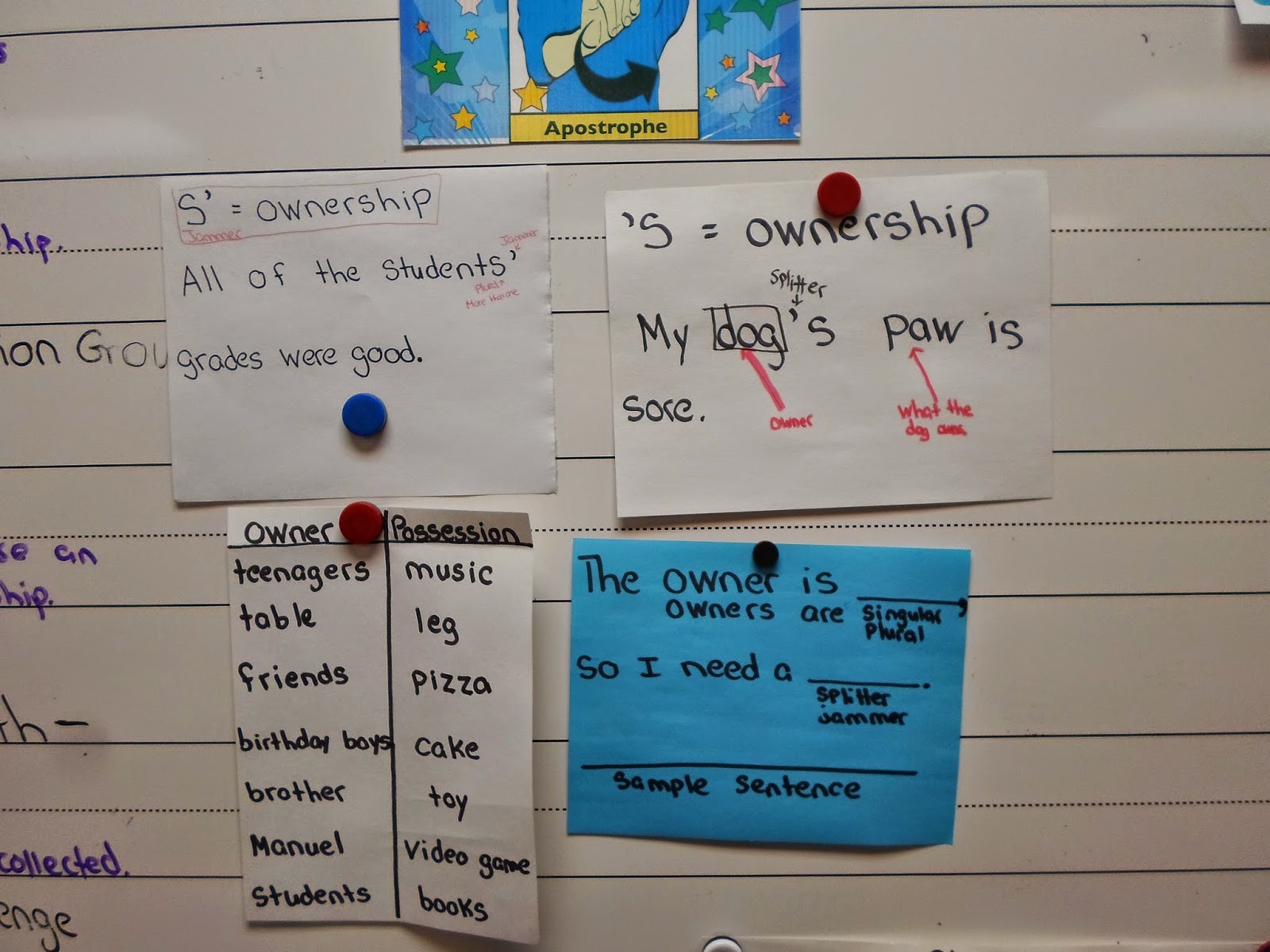
1.  Our focus skill this week in both reading and writing was possessive nouns.  In the past this has always been a challenge to teach and not something that I looked forward to.  This year, however, was very different.  Not only was it a lot of fun to teach, but my students all quickly and easily caught on to how to use apostrophes to make nouns plural.  I firmly believe that this was mainly due to the WBT way of introducing possessive nouns:  splitters and jammers.  

A splitter is the WBT name for an apostrophe "s" that is used with a singular noun or an irregular plural noun, such as children.  I explained to the class that the splitter (the apostrophe) splits the owner from the "s".  I called the "s" the "badge of ownership" and used the gesture of pointing a thumb on each hand to the front of my shirt.  I would box the noun to show the owner and then talk about how the splitter split the owner and the badge of ownership.  During writing we played the complexor Game. (More information on the Complexor game can be found in other blog posts or on the WBT website under free downloads/The Writing Game.)This gave students many opportunities to orally write sentences with apostrophe s's.  They then wrote the sentences that they had created in their writing notebooks.

A jammer is an apostrophe that follows a plural noun which ends in "s".  I explained to my students that the jammer jams the "s" into the noun, making it plural.  The jammer becomes the "badge of ownership".  The concept of the "badge of ownership really helped my kids to remember to write the apostrophe after the "s".  The kids simply learned that there is always an apostrophe after a jammer, because that is how you show ownership.  We also played the Complexor game with plural possessives and wrote the sentences created in our writing notebooks.

After studying splitters and jammers separately, we combined them together and students had to determine when to use a splitter and when to use a jammer.  This is what the board looked like for that lesson:
                                                             

You will notice the apostrophe Brainie at the top of the board.  We obviously focused on this Brainie for the entire week.  Under that you will see two anchor charts that I created, one for singular possessives and one for plural possessives.  On the day of this lesson I added the list of owners and possessions, as well as the sentence frames.  Using Teach Okay and High Five Switch, students took turns sharing with their partners whether or not the owner was singular or plural and whether they needed to use a splitter or a jammer.  They then had to create a sentence using the owner and the possession, in which they used the apostrophe Brainie.  After students had time to work on this with their partners, they shared with the class using High Five Teach.  I was amazed at how well they had caught on.  Even my lowest students were able to explain when to use a splitter and when to use a jammer.  I will never teach possessive nouns any other way,


2.  Our phonics skill for the week was creating plurals with nouns that end in "s".  In the past I have always taught this in the form of a year.  This fit perfectly with WBT.  Students still learned the cheer, but they learned it using Mirror Words and Practiced it using Teach Okay.  We call it the "Five Finger Rule" cheer.  The cheer goes like this:  If a word ends in s, x, z, sh, ch (hold up one finger for each), you gotta (bend left arm in front of chest with had in a fist.) add (Do the same with right arm.) "es" (Very slightly raise fists on both hands.), yes!  (Jump in the air and bring bent arms out straight.)  The kids have so much fun doing this cheer, and by the end of the week everyone knows when to use an "es" to make a word plural.

3.  We did two Genius Ladders last week that were both very challenging, but the students did a great job on them.  They both focused on possessive nouns, but on one there was an apostrophe "s", and on the other there was an "s" apostrophe.  On both I included a dependent clause telling when.  This is our newest extender.  We have been working on it for about three weeks.  Both ladders were very challenging.  The sentences were quite long and there were a lot of Brainies in them, but the kids did a great job!  I was very proud of them.

4.  For red/green writing I asked the students to write a five paragraph essay on what they did over spring break.  I am happy to report that fifteen out of my seventeen students can now successfully write  a five paragraph essay.  My biggest celebration is that one of my two lowest students, a special ed. child who began the year as a non-reader, was able to write for the very first time (with a little assistance) his very first five paragraph essay.  The class celebrated with him as he earned a Super Improver Star.  I also had a number of students use possessive nouns correctly in their writing.  They were all quick to point this out to me, because they were all looking for a Super Improver Star.  I am happy to say that they each earned one.

5.  This week I introduced students to the Brain Tree.  If you are unfamiliar with the Brain Tree, that is because it is the newest WBT technique, hot off the presses just a few weeks ago.  The concept is simple.  Students score themselves from a 1-5 on different WBT techniques that they are using in the classroom.  An analogy is made to an Oak tree.  A one is an acorn, all the way up to a five, which is a mighty towering oak tree with many acorns.  Points are considered leaves, and each week scores are added together to get a total number of leaves for the week.  The goal is for students to beat their previous week's score.  At our school we are having a little friendly competition among participating classes.  Everyone who is doing the Brain Tree has placed one on their door, with their scores.  This will allow other classes to see these scores and try to beat them.  

This was our first week using the Brain Tree, so I wasn't sure how my students would respond to it or how they would do with scoring themselves.  I was very pleasantly surprised.  They caught on to the concept very quickly, and when it came time to give themselves a score, I was amazed at how honest and accurate they were.  The Brain Tree is definitely a great tool  to motivate students.  I am excited to see how they progress each week.  They have set a goal for themselves to have a perfect score (a five in each area) by the end of the year.  That sounds like teacher heaven to me.  We'll see how it goes.  

If you are interested in using the Brain Tree in your room, I have inserted a link with directions and the chart.  I blew my chart up using the poster maker and added pictures of the five different stages in an Oak Tree's development.  Here is the link:


6.  One of my students came up with an idea that we tried, and it has really worked well.  Whenever I ask my students to share with each other using either High Five Teach or Uh/Oh Switch, the student who is sharing stands.  This works really well when the students are at their seats, but when they are seated on the floor in the meeting area, I have told my students not to stand.  One day during the week we were in the meeting area about to use High Five Teach, when one of my students raised her hand and suggested that the student sharing do so while on his/her knees.  I wasn't sure how this would work, but I said that we would give it a try.  It has been great.  The students love it, and it allows them to move a little, even if it is just a change of position, while they are on the floor.


7.  We have been working really hard in reading on two things:  paraphrasing and remembering detail adders.  I have spoken to my students about the need to stick the detail adders in their minds and have used the analogy of velcro to help students get that visual image.  We have also talked about the importance of sticking the first and the last detail adder because if we do that, the ones in the middle are easier for our brains to remember.  This lends itself to paraphrasing because if students are able to stick the details in their brains, they will easily be able to paraphrase what they are reading.  We have been practicing this in reading groups, but I decided to see how it would work as part of the Crazy Professor Game.  (This is another WBT game that can be found on the WBT website under free downloads.)  I gave students a fiction passage entitled The Difficult Assignment.  We read the first paragraph using Mirror Words.  I then asked the students to read the paragraph on their own using their Brainies and their gestures, but I also gave them the goal of making sure that they stuck the first and the last detail adders in their minds, to help them with the middle ones.  We even started calling this a detail adder sandwich.  Students then used Uh Oh Switch to paraphrase that first paragraph with their partners.  We repeated this process with each paragraph.  I am happy to report that even my lowest students were able to paraphrase.  Next time we are going to try this with a non-fiction text.


So, there you have it.  Those are the highlights of the week.  I hope that the ideas and experiences that I have shared in this blog will inspire you.  Here's to more week's just like this one!

Thursday, March 26, 2015

Planning

It is really hard to believe that next week is spring break and that I am right at a couple of months short of completing my first full year as a Whole Brain Teacher.  It has been an amazing year!  I have learned so much as an WBT intern.  I am so grateful to Nancy, my mentor, and to Coach B. for all of their help and encouragement.  Over the course of this school year I have written about a variety of techniques, skills, and strategies that you would find in a WBT classroom.  For this blog I have decided to answer a question that a lot of people have asked me this year:  Do you find that planning is easier or harder when you are doing Whole Brain Teaching?

The answer to that question is simple.  It is so much easier!  O.k, to be honest, it was harder in the beginning, but that was because everything was so new to me and I had so much to learn.  It took time to figure out how all of the pieces fit together.  Now, I can honestly say that I spend a lot less time planning than I used to.  I think that this is mainly due to the fact that the structures (The five step lesson, Power pics, The Genius Ladder, Teach/Okay, Mirrors, Red/Green Writing, Brainies,  the use of Sentence Frames etc.) are already there.   I just have to plug my lessons into them.  I have found that with so many tools, I can easily weave instruction of a new concept into multiple parts of my day.

A perfect example of this is a unit that we just completed last week.  Our class spent two weeks learning about Point of View and Dialogue.  The first week I focused on point of view.  The five step lesson format made planning very easy.  I began by creating a Power Pic for point of view.  Deciding on my question and answer was very important, because I knew that it was these two things that would guide my instruction.  Below is my Power Pic:


Question:  What is point of view?
Answer:  Point of view is who is telling the story:  first person, a character; second or third person, the author.
Gestures:  Shrugging shoulders and then holding up one finger at a time for each of the three persons.

I knew that each day that week I would begin with my question and answer.  When thinking about how to expand my lesson, my first step was to create a sentence frame.  I use sentence frames on a regular basis.  They provide a support and structure for my students, especially my ELL students, as they share during Teach Okays and Call-Outs.  I chose the following frame:  This story is being told from ________________.  I know this because ________________.  When planning any lesson I automatically include opportunities for students to prove their answers using a "because clapper".

This led to the question, "What do I expect my students to use for proof?"  I quickly decided to use the WBT concept of "Power Words".  I created an anchor chart with a tree map.  On the tree map I placed my power words for first second and third person, along with my sentence frame.  Below is a picture of it.  This anchor chart stayed in the front of my room and became a reference for my students during the entire unit.  Below is a picture of it.

                   
Once this was done, the rest was very easy.  The main way that I taught the concept was to read short paragraphs and using Teach/Okay ask the students to share from what point of view the text was being told and how they knew.  I would remind them to use the sentence frames on the anchor chart.  For proof they would say things like, "I know this because I heard the Power Words he, she, and their.  For a couple of days I read the same scenarios, but from different points of view.  Students would use these same sentence frames to discover the point of view that the books they were reading were being written from.  At the end of independent reading time, students would first share with their partners using Teach/Okay and then with the class using Call-outs.

The last step of the five step lesson plan is critical thinking.  This is usually done through writing.  During Red/Green writing I gave my students a short story about a cat named Cupcake who ran away from a campground and walked 150 miles to get back home.  The story was told from third person.  I asked my students to rewrite it from first person, the point of view of Cupcake.  We did some oral writing practice first, and then they began.  The students did a really nice job.  Below is one of their stories.


During this first week, something happened that I was hoping for.  I shared a text with quotation marks.  The character speaking used the word "I'.  Some of my students immediately thought that this had to be first person.  This led to the introduction of quotation marks.  It was a perfect lead-in.  In the past I had always struggled with the best way to teach quotes to second graders, but this year it was easy.  I began with the Quotation Mark Brainie.  My students were familiar with it, because I had previously pointed quotes out to them in text and they had used the Braine, but they really did not understand this Brainie.  I decided that the Brainie would serve in a way as my Power Pic.  This led to me deciding upon the following question and answer:

Question:  What are quotation marks?
Answer:  Quotation marks are talking marks.  They go around the exact words that come out of a character's mouth.
Gesture:  The gesture for the quotation mark Brainie.

Over the course of the week I gave students short stories with lots of quotation marks.  We would do what I called the one minute drill.  They had one minute to underline all of the quotes.  (Of course, I first demonstrated how to do this.)  They then had to read the passage with their partner using their gestures and Brainies, with an emphasis on making sure that the quotes were done properly.  (This had also been modeled numerous times.)  I then asked students to tell their partners (Teach/Okay) the point of view that the story was being told from (Students used the sentence frames on the anchor chart.) and then called on a student to share using a Call-Out.  We then focused on the quotes.  Using High Five Switch, the students had to take turns reading the quotes in order and telling who said it and how they knew.  As they shared, they were expected to use their Brainies, especially quotation marks.  I emphasized the comma and using a capital Brainie for the first word at the beginning of a sentence inside of the quotation marks.  Of course I provide them with the following sentence frame:  ______________ said __________________.  I know this because ___________________.  For their proof they usually said something like, "I know this because it said _______ said after the quotation marks."

As I did with point of view, I asked the students to find quotes in the books that they were reading and to share at the end of independent reading time, using the sentence frames that I had provided.

They were doing so well with all of this, that I decided to take quotation marks to a Genius Ladder and see how well they did at it.  Below is the Genius Ladder that I used.


The students had a really good time with the simple sentence that I chose.  At the Genius level students were asked to write a conversation with themselves and their mom.  Most of my students were correctly using quotes, not forgetting the comma before or after the quote, and were capitalizing the first word inside the quotation marks.  This can be attributed to all of the oral writing that they had been doing with quotation marks.  I was really impressed with how well many of them did at changing paragraphs when they changed speakers.  My students were already very familiar with paragraph form and the indent Brainie, so this wasn't that difficult for them.  You may have noticed that at the extender level I introduced my students to the dependent clause.  This is another Brainie that we had not previously talked about.  Prior to this time, they were not ready for it.  They still needed more work on it.  It will definitely be the focus of our next few Genius Ladders, but they are beginning to catch on.  It just amazes me the caliber of writing that you can get from second graders and what they are actually capable of understanding.  Prior to finding a Whole Brain Teaching I would have never imagined that my students would be writing conversations so effortlessly with quotation marks and in paragraph form, nor would I have believed that they would be able to correctly write complex sentences with dependent clauses.

As a side note I wanted to point out that towards the end of this time we began an explanatory text unit in writing.  Right away one of my students raised her hand and said, "We are going to be writing from second person."  It was one of those moments when all I could do was say a quick prayer in my head, thinking God for Whole Brain Teaching.

I hope that you have found this look into my planning process helpful.  Happy teaching!


Thursday, March 19, 2015

The Appositive Brainie and the Genius Ladder

I love the Genius Ladder.  It is absolutely one of my favorite parts of the WBT writing program.  It teaches students parts of speech and sentence structure in an engaging and meaningful way.  There is nothing else quite like it.  If you are unfamiliar with what the Genius Ladder is, please see my post on the Genius Ladder.  In that post I explain all of the levels of the ladder and exactly how to use it in the classroom.

In this post I would like to focus on the Extender Level.  At the Extender Level students are shown how to extend simple sentences.  I personally believe that it is all of the practice that my students have had at this level of the Genius Ladder that has helped them to punctuate their sentences properly.  In previous years a very common writing error made by my students looked something like this:  I was playing ball with my friends.  At the park.  This year I have not seen any errors like this, and I mainly credit the Extender Level of the Genius Ladder for this.  My students now not only understand what it means to extend a sentence, but they know all of the different ways that it can be done, and they get practice with this on a regular basis.  As a result, the majority of the time my students' writing is punctuated properly.  To be honest, it has never been so easy or effortless to get kids to put periods in the proper places in their writing.  (As a side note, let me just say that other components of the WBT writing program play a role in this as well, especially the Brainies.  There is definitely a synergistic effect in WBT writing.  However, it is the Genius Ladder that really helps students understand and apply sentence structure.)

Through January of this year, I had taught my students the following extenders:  because, telling when, telling where, prepositions, a dependent clause starting with if, and the conjunction but.  They were doing quite well with all of these, so I began to think about where I wanted to go next.  Looking through the Brainies I saw that I had not yet taught my students appositives.  Some of you may be thinking that second grade is a little to young to learn appostives, but in reality it is not.  Students come across them all the time when they are reading non-fiction text.  Here is an example of an appositive found in non-fiction text:  Owls, nocturnal animals, sleep during the day and are active at night.  Students do not automatically know how to read the appositive ", nocturnal animals,".  This is something that they must be taught.  Since we were doing informative/explanatory writing and were also reading a lot of informational text in reading, it seemed like the perfect time to introduce students to the Appositive Brainie.  Not only would they learn a new extender, but they would be better able to comprehend non-fiction text, because they would better understand its structure.  Of course, appositives can be found in any type of text, so I knew that learning this Brainie would help my students with any type of reading they were doing.

Although, I wanted to focus on non-fiction text, I decided that it would be easier for my students to understand what appositives were if I began with narrative text.  I began by telling my students that they were going to be learning a new Brainie.  This statement alone was enough to get them excited.  They immediately began trying to guess which Brainie it was.  After telling them that they would be learning the appositive Brainie, I showed them the gesture associated with this Brainie.  I then used the Genius Ladder to introduce it.  The extender level sentence that I used was the following:  My little sister, who is always bugging me, broke my new game.  Since this was the first time that we had looked at an appositive, when we reached the extender level, I spent some time defining it through the use of Mirror Words and Teach Okays.  I told my students that it was like a Post-It note that you put on a sentence.  You don't have to have it.  You can take it away anytime that you want, but it makes your writing more interesting by giving the reader more details.  I then used the sentence at the extender level, but provided the students with additional examples using Mirror Words and Teach Okay.  One of my examples was the following:  My little sister, Sharon, broke my new game.  This example was very important because my lowest students, who could not think of anything else, were able to insert a name.

After a few days of this, I felt like my students were ready to try it with non-fiction text.  We were reading a passage at the time on tree rings, so I put up the Genius Ladder that you see below.  The appositive at the extender level was added with the help of the students.


Students were asked to use an appositive to define tree rings.  I have to be honest.  This was not easy for them.  They worked with a partner to read their passage and come up with a definition.  With some guidance, they did it.  I wanted them to go through this process so that they could see how appositives are used to define vocabulary in non-fiction texts.  We have done similar Ladders with appositives on different non-fiction topics since finishing this first one.  Each one has gotten a little bit easier for them to do.

The real breakthrough came when students began noticing appositives in their reading and pointing them out to me.  I have a few students who have also begun to use them in their writing, which is what I was hoping for.  These students have all received Super Improver Stars, which is motivating the rest of my class to try using them.  

Although this has probably been the hardest Brainie that we have learned so far this year, it has definitely been rewarding and a lot of fun.  I am very thankful for both the Brainies and the Genius Ladder.  They are definitely the rock stars of WBT writing.  I would love to hear how you are using the Genius Ladder and Brainies together in your room.  Please share by leaving a comment.  Happy writing!

Thursday, February 5, 2015

Writing the WBT Way

Writing has never been so easy to teach.  The results are almost effortless.  I never imagined that my students could produce such great writing.  There is nothing like the WBT writing program.

Whole Brain writing is like the perfect recipe.  It takes the right combination of ingredients, in just the right amounts, mixed together on a daily basis to create a masterpiece that causes anyone who experiences it to say, "I must have that recipe!"  In other blog posts I have talked about all of the ingredients in the WBT writing program.  In this post I would like to show you how some of those ingredients came together over a two week period within my writing block to produce some very exciting results.

It was time for our class to begin informative writing.  I gave a lot of thought as to how I wanted to start this unit, and I decided that I definitely wanted to incorporate the compare and contrast Brainies into whatever we did.  We have already used them a lot this year, but I had never asked students to compare and contrast information taken directly from non-fiction informational text.  This seemed like a logical next step.

I began by bringing in a short passage that compared lions and tigers.  The first day we read the passage together using Mirror Words, Brainies, and story telling gestures.  I then had the students take out their red and green pens, and we went through the passage one sentence at a time.  Using Teach Okay, students had to decide if the sentence told about lions, tigers, or both lions and tigers.  They also had to use a because clapper to explain why they made that choice.  If the sentence referred just to lions, they underlined it in red pen.  If it referred just to tigers, they underlined it in green pen.  If it referred to both lions and tigers, then they underlined it in both colors.  This took one full day,

On day two, we began writing.  I was asking students to write two paragraphs.  One paragraph would explain how the animals were the same, and the other would explain how they were different.  Each paragraph had to have a topic sentence, detail adders, and a concluder.  The details had to come from the text and had to be paraphrased.  This one we worked on together.  I wrote  on the board, while students wrote in their journals.  There were a lot of Teach Okays going on as students worked together to paraphrase the ways that the lions and tigers were similar and different.  They shared their paraphrases with the class using Call Outs.  A call Out is used when a student is going to share with the entire class.  The purpose is to engage the entire class in the sharing.  The student stands and says class, followed by Mirror Words.  The student then shares using Brainies and gestures.  The rest of the class repeats both the student's words and gestures.  We spent one day writing our similar paragraph and one day writing our different paragraph.

I would like to spend a few minutes talking about paragraph number two - how lions and tigers are different.  I wanted to use this opportunity to show students how to use the "but/however" Brainie to contrast.  My students already were very familiar with the "but" Brainie.  We had spend a lot of time previously working on it.  We had played the "But Complexor Game" (See the WBT Writing Game for more information on this.)  We had also done numerous Genius Ladders with "but" extenders.  Therefore, it was very easy to model for them how to use the this Brainie to contrast two items.  However, the "however" Brainie was new to them.  I needed to spend some time teaching it in the context of contrasting, before I could expect them to use it in their writing.  So, I decided to use the Genius Ladder for this.  Below is the Genius Ladder that we used.  Students quickly got the idea.  That afternoon a few of them had already started using the "however" Brainie in their red/green writing.  (If you are not familiar with red/green writing, please see my blog post on this topic.)


The next step was to have students work together.  I gave students a new passage about Polar Bears and Brown Bears.  The same process was repeated, except that students did everything with their partners.  I circulated and assisted as needed.  It was amazing listening to the dialogue and watching the Brainies that they were using as they worked together to write their two paragraphs.  

The last step was for students to repeat the same process independently.  I chose a passage about butterflies and moths.  Before they began writing, I introduced them to a new writing rule that was added to our writing wall:  Two sentences in a row never start with the same word.  (You can read more about this wall in my post on red/green writing.)  Below is a picture of the wall.


To assist students with this, I asked them to do a little of their own red/green writing.  Using their green pens, they had to circle the first word of every sentence.  Then it became very simple.  No two circles in a row could be the same.  They thought the rule was very grown-up, and they especially liked using their green pens.  

I did not give students any assistance.  I wanted to see what they could do on their own, after having gone through this process.  I have to say that I was very pleased with the results.  The students did a great job.  They were able to write two indented paragraphs with topic sentences, paraphrased detail adders, and a concluder.  Below is a sample of their writing.  This was done by one of my average students.  Notice that in paragraph two he used the words "however" and "but".  This is something that all but a couple of my very lowest students were able to do.  I would also like to point out that this student drew a smilie face each time he indented.  This is something that I often do during red/green writing.


As you can see for yourself, Whole Brain writing really works!  So what are you waiting for?  Give it a try in your own classroom.  I can promise you that you won't be sorry.

Thursday, January 15, 2015

Common Core Curriculum and the Genius Ladder

I love the Genius Ladder!  It is one of the core components of the Whole Brain Teaching writing classroom.  If you are not familiar with what the Genius Ladder is or how to use it, please see my post entitled The Genius Ladder before reading any further.  There you will find a full description of what the Genius Ladder is and how to use it within your classroom.  I have been using the Genius ladder faithfully since the second week of school.  I have always chosen the content of my ladder based upon what type of extender I wanted to use.  I began with the because clapper.  From there I moved on to phrases that answered the questions "when" and "where".  Next, it was on to prepositional phrases.  I then taught my class how to form compound sentences.  Most recently, my class learned how to use the conjunction "but".

I could have easily continued making my ladders based upon the type of extender I wanted to use, but recently I decided to try something different.  I decided to build my ladder around our common core content.  With the Common Core, the rigor our curriculum has definitely increased.  Students no longer just need to know the answer.  They also need to be able to explain their reasoning in writing.  I decided that the Genius Ladder would provide the perfect framework for students to do just that. I also made the decision to combine this use of the Genius Ladder with Red/Green Writing.  This made perfect sense to me, since one of the topics that students are encouraged to write about during Red/Green Writing is what they have learned about that day.  The Genius Ladder would simply provide more structure.

The first step was to decide which standard to use first within the ladder.  In math we are learning how to subtract with regrouping to the tens place.  Any second grade teacher who has ever taught their students how to do this knows how challenging this can be.  Students need to understand when and why they take a ten from the tens place and trade it in for ones.  It was upon this premise that I built the day's Genius Ladder.  Below is a picture of what it looked like.


The first level, the Blah level, simply says, "The student traded in a ten for ten ones."  At the spicy level I asked students to think of an adjective to describe a student who knew that he needed to trade in a ten for ten ones.  I used the word smart.  My students came up with a number of adjectives  that included brilliant, brainiac, genius, and bright.  At the extender level I asked my students to use a "because clapper" to provide a reason why a student who need to trade a ten for ten ones.  They answered the question using a "Teach Okay" and then shared with the class using call outs.I then wrote in the Genius Ladder what the students shared.  (Normally, I would already have the extender level of the ladder filled in, but since I wanted the students to provide the reason, I wrote it in the ladder after they came up with it.)

It was now time for the Genius Paragraph, which meant that it was time for the students to do some writing of their own.  First we talked about writing a "detail adder" that began  the "For example" Brainie.  We have used this Brainie a little bit in class, but I wanted to provide students with a more structured opportunity to include it within their writing.  I decided that it fit perfectly with this lesson.  Students then used "High Five Teach" to share examples of times when you would not have enough ones to solve a subtraction problem.  Since students had been orally doing something similar during math time, it wasn't too difficult for most of them to think of examples.  After sharing with their partners, I then asked a few students to share with the class.  What really impressed me was how many students used the "If, ___ then" Brainie in their "detail adder" sentence.  We had done a lot of practice with it previously, and it was great to see that students could apply it to a new situation.

Please note that it is very important that students are provided with many opportunities to write orally before they record their thoughts on paper.  While engaging in this oral writing practice students are using their "Brainies".  (Please see my posts on the Brainies.)  The Brainies do a great job of helping students learn the conventions and grammar of the English language.  I have found that this oral writing practice results in significantly fewer errors when students are ready for paper/pencil writing.

It was then time to write.  Students each have a writing notebook that they do their Red/Green Writing in each day.  Students only had around ten minutes to record their thinking, so I was only asking students to write down their topic sentence and one detail adder.  I walked around the room with my red and green pen making marks on the students' writing. ( If you are not familiar with Red/Green Writing, please see my post on the subject.)  Below is a sample of one of my low/average ELL student's writing.  I took a picture of the page in her notebook that contained her Genius Ladder writing.  What you see below it is the writing that she began the next day during Red/Green Writing.


I was very pleased with how this lesson went.  I am looking forward to finding more ways to use the Genius Ladder to reinforce Common Core concepts in all subject areas.


Thursday, December 4, 2014

A Closer Look at a Writing Lesson

One of the things that I love the best about Whole Brain Teaching is the way that writing is taught. Over the years I have seen and have used so many writing programs and methodologies in which students are given a lot of time to practice writing, but what they are practicing is the wrong way to write.  This revelation did not occur to me until I started teaching writing the Whole Brain way.  In Whole Brain Teaching writing is broken down into its smallest components and taught to the students in such a way that what they are practicing is the correct way to write.  I would like to demonstrate this by sharing with you a lesson that I recently taught on compound sentences and the joining word "but".  I used the WBT 5 step lesson plan and taught this lesson over a period of three days.

If you are not familiar with this format, please see my blog post entitled, "The Five Step Lesson Plan."  Before sharing with you my lesson, there is one thing that I would like to point out.  During the explanation portion of the lesson it is so important that you chunk the information that you are sharing with your students into very small parts.  The longest you should be talking at any one time before asking the students to share with their partners (Teach Okay) is around 30 seconds.  The general rule is that you share information with the students using "Mirror Words" (students repeat your words and copy your gestures) and immediately follow this with "Teach Okay".  (You say, "Teach."  The students respond "Okay."  They then turn quickly to their partners and share what you have just taught them.)  This is not an easy thing to do.  As teachers we are used to talking.  Getting into the habit of chunking your lessons takes time and practice.  This is something that I have recently really been working on.  I found that the best way to make sure you are doing this is to decide in advance at what places in your lesson you are going to have your students do "Teach Okays".  Honestly, when I started teaching this way there were times where I thought that this was impossible.  What I discovered, however, is that when I forced myself to plan a lesson around the idea that I was going to chunk it, my lessons turned out better, and my kids did a much better job of understanding and retaining the information.

In the lesson below I have written all of my "Teach Okays" in red, so that you can more easily see how many small chunks I broke my lesson into.


Question:  "Our question for today is, what is a compound sentence?"  Teach Okay

Answer:  "A compound sentence is two sentences (hold up to fingers) put together to make one sentence (with other hand grasp two fingers and pull them together)."  Teach Okay

Explain:  (Have a compound sentence with the word "but" written on the board.)  "Today they are going to learn how to form a compound sentence using the conjunction "but.  Tell your partner what you are going to be learning today."  Teach Okay  Remind students that "but" is one of our Brainies.  Using "Mirror Words" and "Brainies" read the sentence on the board.  Teach Okay  "Mirror Words.  (use Brainies)  The first sentence is ..."   Teach Okay  "Mirror Words.  (use Brainies)  The second sentence is ..."   Teach Okay  "Mirror Words.  But joins the two sentences together."  Teach Okay


Explain to students that you use the word "but" when you are comparing.  Using the sentence that you have already read, point out to students what you are comparing.  (For example, if your sentence was "Johnny can run fast, but Mark can run faster," you would be comparing how fast Johnny and Mark could run.)  "We are going to read some more sentences together.  It is going to be your job to decide what we are comparing.  Mirror Words.  (Read Sentence using Brainies.)  Teach Okay
Repeat with two to three other sentences.

"This time I am going to give you the first sentence.  It will be the job of you and your partner to finish the compound sentence.  Don't forget your comma and your joining word.  We will be using High Five Teach (In High Five Teach students take turns sharing.  I have taught my students that the person sharing stands up, and the other student must repeat his words and copy his gestures.  This increases student engagement.  When one student is done sharing he high fives his partner and sits down.  His partner then stands up and begins sharing.)  Mirror Words.  (Read sentence using Brainies.)  Teach Okay
Repeat with three to five other sentences.

Next, play the "but" complexor game.  Directions for this game can be found in "The Writing Game".  This is a free download that is available at www.wholebrainteaching.com.  All you have to do to receive the downloads is register on the site.  Once you do they will be available to you on the right side of the screen.  Click on downloads.  Scroll through until you find "The Writing Game".

Please note the number of "Teach Okays" in the explain portion of the lesson.  Depending on how many sentences you choose to do with your students, you could be doing anywhere between eleven and fifteen "Teach Okays".

Test:  It is in this portion of the lesson that we check students' understanding.  "It is time for QT."  (This stands for question time.  The kids will respond "Cutie".  They then put their heads down and lay their hand flat on their desks.)  Ask students the following question:  "Is this sentence correct?"  Have ready a list of sentences to read to the students, all using the word "but".  Make sure that some of the sentences are using "but" correctly, and some are using "but incorrectly.  Students listen to the sentence and respond with either a thumbs up or thumbs down.  This tells you as the classroom teacher who is getting it and who isn't.  This allows you to either go back and reteach or move on.  It also lets you know which of your students you might want to pull for further instruction at a different time.

Critical Thinking:    Guide students orally through the first three rungs of the Genius Ladder (For more information on the Genius Ladder, see my Blog Post on this topic.) using the following sentences:
Blah:  my brother's favorite food is pizza.
Spicy:  My brother's favorite food is hot, cheesy pizza.
Extender:  My brother's favorite food is hot, cheesy pizza, but my favorite food is cold ice cream.
Genius Paragraph:  Students create their own paragraph using the structure of the extender sentence as their topic sentence, but changing the foods and people as they want to.  They must give detail adders and a concluder (concluding sentence).  This is done orally at first, but then the students are asked to put their paragraph into writing.

It is important to note that at every level of the Genius Ladder students are sharing using Teach Okay and Tag Team.  While the students are writing their paragraphs, I walk around the room with my red and green pens to do red/green writing.  If you are unfamiliar with what red/green writing is, please see my blog post on this topic.

I hope that you have found this lesson helpful and that it inspires you to take a closer look at your writing program.


Thursday, November 6, 2014

The Genius Ladder

The Genius Ladder is at the heart of the WBT writing program.  At its core it is 10-15 minutes daily of oral writing practice, but in reality it is so much more!  It teaches sentence structure, parts of speech, grammar, and what a paragraph is.  It can also be a springboard to numerous writing assignments, as well as a way to reinforce content in areas like science and social studies.  Finally, it engages your students by bringing "funtricity" to your writing program.  Below is a picture of my Genius Ladder.  Mine is a little on the large side.  I have discovered that though not necessary, having a Genius Ladder this big definitely gets the kids attention, so I am okay with it.  The traffic light transitions on the side are not a part of the Genius Ladder.  The side of the ladder just seemed like a logical place to put them.


The Genius Ladder has four rungs to it.  The first rung is called "Blah Sentence".  Here you write a simple sentence with an article, noun, verb structure.  An example would be, "My dog ran."  For the first four or five weeks of the school year, my students would use "Teach Okay" to create new sentences, by first substituting the noun in the sentence with new nouns, and then substituting the verb in the sentence with new verbs.  In the first round an example of a new sentence might be "The girl ran."  In the next round they might say, "The dog barks."  I found that doing this daily provides students with a really good grasp of nouns and verbs, as well as the structure of a simple sentence.  At the end of "Teach Okay" I always ask two or three students to share their sentences with the class using "Giant Mirrors and Words."  This sharing provides another opportunity for a whole class model.  At this point in the year my students understand nouns and verbs, as well as the simple sentence structure, so we just read the Blah sentence.  When we are done, the kids love to say, "Blah, boring."  This allows us more time to spend on the higher levels of the ladder.

The next level is the "Spicy Sentence".  At this level you add an adjective to your "Blah" sentence.  Just like the first level, students use "Teach Okay" to share their new sentences.  An example of a "Spicy Sentence" would be, "The large dog ran."  As students take turns sharing their sentences, they are constantly thinking of different adjectives.  Right now I have students that will create "Spicy Sentences" with two or three adjectives.  After "Teach Okay" I choose two or three students to share using "Giant Mirrors and Words."
I love this level, because students really begin to understand what adjectives are and how to use them properly in sentences.

The next level is the "Extender Sentence".  At this level the "Spicy Sentence" can be extended in any number of ways.  I decided to start my year by having my students extend their sentences using the "Connect 5 W + H" Brainie.  This Brainie is simply teaching students "who, what, when, where, why. and how."  I began by teaching my kids how to extend their sentences by answering the question "why".  We did this using the "because clapper".  We then answered the question "when" by extending our sentence with phrases like "in the morning" or "After dinner".  Finally, we answered the question "where" and students extended their sentences with phrases like "outside" or "at the "park".  Most recently we used both "when" and "where" to extend our sentences.  Next on the agenda is compound sentences.  Later in the year we will do prepositional phrases.  The same procedures are followed at this level as the previous two.

The last rung of the ladder is called the "Genius Paragraph".  We started working at this level about four or five weeks into the school year.  Here the extender sentence becomes the topic sentence, and students then add details, which are referred to as detail adders.  They also add a closing sentence, which is called a concluder. At this level I have students share with their partners, and then I usually ask one student to share his/her "Genius Paragraph" with the class.  Often I will use the oral writing practice as a springboard to my writing lesson and have my students write down their "Genius Paragraphs".

Just recently I tried my own innovation of the Genius Ladder which the kids totally loved.  I told them that they were each going to create their own ladder.  I provided them with a paper which had all four rungs on it.  On our class Genuis Ladder I posted the structure for each level.  For example, at the "Blah" level I had written "The/A/My noun verb."  I then guided students through each level of the ladder, which they wrote out on their paper.  At the extender level students chose how they wanted to extend their sentence.  Along the way students shared with their partners and with the class, just like we normally do.  The last step was to have the students write out their "Genius Paragraphs."  I was really impressed with the job that they did.  Even my special education students were successful.  To me this assignment was simply a testament to the power of the Genius Ladder.

If you would like more information on the Genius Ladder, you will find some great resources at the Whole Brain Teaching website.  Just go to www.wholebrain teaching.com.  Under Goodies on the drop down menu, go to wbt tv.  There you will find an archive of webcasts.  Number 504 is on the Genius Ladder.  Coach B. will explain to you everything that you ever wanted to know about it.  Also, if you register at the site, you will have access to the free downloads.  There is a great Power Point on the Genius Ladder, which will provide you with tons of sentences to get started.

Tuesday, August 19, 2014

My Writing Program

I love all the components of the WBT writing program.  The more I studied each component, the more excited I became about teaching writing next year.  The question, however, that I kept struggling with was, "How do I put all of these various components together?"  I had the general idea, but I was interested in the nuts and bolts of what writing would look like in my classroom on a day to day basis.  Since I knew that my mind would not rest until I figured it all out, I got to work.  I decided to map out exactly what my first ten days would look like, so that I could get some practice in "putting it all together".  After that I just wanted a general idea of what I would be doing the rest of the year.  You might have already noticed that I am a list maker, so I put these plans in my favorite form:  a list.  Please know that these plans are very tentative and sketchy.  I just feel better having something down on paper.  I would appreciate feedback, especially from any second grade teachers who have already taught WBT writing for a year.

Day One:  Introduce students to oral writing. (Question, Answer, Adders, Concluder will be posted on board.)  Question:  What was the best part about today?  At the end of oral writing students will engage in 10 minute writing.  Teacher will introduce focus skill of neatness and do red/green writing.
Note to self:  At the end of oral writing pique the students' interest in the Wacky Star Fun Button by drawing the first line of a star on the board.

Note:  Oral writing will continue on a daily basis as part of writing lessons or lessons in other subject areas.

Day Two:  Use five step lesson plan to introduce students to what a sentence is.  Have LA pic to display.  Emphasize that from now on we will be answering all questions in complete sentences.  During step three read-aloud short vowel phonic's story.  Ask students to retell the story to their partner using the Two-Finger All-terrain Action Figure with Anti-gravity Boots Brain Toy.  (Poster for each Brain Toy will be displayed in room.)  For step five of the lesson, post the following sentence frame:  The best thing about me is that I am ______________.  (Students are encouraged to add several Adders.)

Oral Writing Sentence Frame:  Today I learned _____________.

Day Three:  Do Coach B's lesson on what a sentence is.  Stop at the end of level one.  (This lesson can be downloaded from the WBT website.  It is under free e-books/common core.)  Also play the Writing Game:  Puzzle one and Complexor "and".

Oral Writing Sentence Frame:  Today I learned ____________ and ____________________.

Day Four:  Using LA Pic, review what a sentence is.  Continue with Coach B's lesson on what a sentence is.  Stop after level two.  Play Writing game using the same puzzle and complexor as yesterday.

Oral Writing Sentence Frame:  The best parts about today were ________________ and ______________.  Students may also choose to use yesterday's sentence frame.

Day Five:  Using LA Pic, review what a sentence is.  Continue with Coach B's lesson through level three.  Teacher will guide students through using each of the following Brain Toys to share with their partner what a sentence is:  Hand Puppets, Air Blackboard, and Props.  Play the Writing Game.  Do Puzzle 3, Subject/Verb Agreement

Oral Writing Sentence Frame:  See yesterday.

Day Six:  Introduce students to the Genius Ladder (first two levels) using the following Blah sentence:  My mom ran.  (There is a free download about the Genius Ladder on the WBT website under free downloads.)
Do Five step lesson on capitalizing the beginning of a sentence.  Display LA Pic.

Oral Writing Sentence Frame:  After school today I am going to ____________ and ______________.

Day Seven:  Begin with the Genius Ladder (first two levels) using the following sentence:  A fireman burped.
Do five step lesson on end marks.  Display the LA Pic.

Oral Writing Sentence Frame:  Students may choose between any of the sentence frames learned with the word "and".

Day Eight:  Play the Writing Game using the Complexor because.  Be sue to teach the "because clapper".  (See the Brainy Game for more information.)
Guide students through level three of the Genius Ladder, using the extender "because".  Students will write as many sentences as they can think of at level three of the Genius Ladder.

Oral Writing Sentence Frame:  See yesterday.

Day Nine:  Begin with the Genius Ladder, orally doing the first three levels with the following sentence:  My sister cried.  Use the extender "because".
Use LA Pics posted on Power Pics Wall to quickly review sentence, capitalizing the first word of a sentence, and end marks.  From Coach B's Common Core Free e-book on what a sentence is, put up the "Cartoon Writing" slide of a cat that says, "In the morning, I _____________."  Guide students through an oral writing lesson with the question being, "What does the cat say that he does in the morning?"  Introduce students to "adders" and the gesture for "adders"  (See the Brainy Game.)  Students follow up the answer to the question with "adders".

Oral Writing Sentence Frame:  Over the weekend I __________ and _________________.  (Today is the first day that students will be required to use adders.  Teacher will not be doing red/green writing today.)

Day Ten:  Look back at the Genius Ladder began yesterday:  My sister cried.  Review what students learned yesterday about adders, and guide students through orally completing the Genius Ladder.  Students write an extender sentence, followed by as many adders as they can.

Note:  During the first ten days of school, I also plan on introducing students to nouns, by playing Electronic Super Speed Grammar daily.

Oral Writing Sentence Frame:  Teacher will give students red and green pens and they will do their own red/green writing on writing done yesterday.

During the remainder of September and the first week of October, my goal is to focus on teaching different extenders, through the use of the Genius Ladder.  I will use the Writing Game to assist me with this.  During oral writing I want to introduce students to Concluders, and teach the the Brainstorming Puzzles in the Writing Game.  I would also like to spend some time on verbs, using Coach B's free Common Core e-book download and Electronic Super Speed Grammar.

Note:  If I feel my students are ready, around the end of September or beginning of October, I would like to introduce students to the "Triple Whammy" sentence.  As the year progresses, I can teach students how to add a detail sentence for each part of the "Whammy" and a Concluder.  This would take place during red/green writing time.  I will create sentence frames to post on the wall that students can use to guide them in how to do "Triple Whammy" writing.

For the remainder of October I will work on explanatory writing.  I do a unit every year in which students write a book on "How to Make an Ice Cream Sundae".  For our Halloween party, I make each student's sundae, according to the directions in each of their books.  I am very literal, so it can be quite hilarious, especially when a student writes something like, "Put one scoop of ice cream on the bowl."  During this month I will also focus on transition words.

For November and the first week of December my focus will be topic sentence paragraphs and simple essays, using the Puzzles in the Writing Game as a guide.

For the remainder of December I will work on letter writing, using the Letter Writing Puzzle in the Writing Game.  This unit will culminate in letters to Santa.

In January and February my focus will be on narrative writing.  Within the writing game I will use "adjective noun" and "descriptive sentence" complexors, as well as the Narrative Puzzle to work on writing narrative pieces.We will also spend time on "College Talk" verbs, and I will introduce students to conjunctions and compound sentences.

In March my focus will be research writing.  I will introduce students to the "Paraphrase Complexor".

In April my focus will be Opinion Writing.  I will consider using the "Argumentative Puzzler".

For the remainder of the year I will focus on more advanced essay puzzlers.  I will also teach compound complex and mega complex sentences.