Showing posts with label Management. Show all posts

Thursday, July 9, 2015

Diamond Rule Update

Today's post will be short and sweet.  I simply wanted to share with all of you a change to the Diamond Rule that Coach B. unveiled at the National Conference.

Many of you will remember that the Diamond Rule first came out last fall:  Look at the one who is teaching.  This was a very important rule because in Whole Brain Teaching it is often the students who teach each other.  If you would like to know more about this rule, please see the separate post that I have written on this topic.

After almost a year of implementation, we all began to realize that there was something missing and this rule could be made even better.  The problem with the old Diamond Rule is that we don't always want our students' focus to be on the teacher or another student.  Sometimes we want them looking at a chart, a book, or a power point.  This is what led to the new and improved Diamond Rule:

Keep your eyes on the target.

Now when we ask or gesture for the Diamond Rule, our students will know that their eyes are expected to be on the target, whatever that target might be at the time.  I am excited to begin the school year with the new and improved Diamond Rule.  I hope that you will be too.

Thursday, April 16, 2015

Reflections on an Awesome Week!

Last week was an awesome week!  If you were to ask me why, I don't think that I could name just one thing.  Instead, I would have to say that it was a combination of many things, all of which were WBT related.  I would like to share with you my list of what made last week one of my favorite teaching weeks of the year.

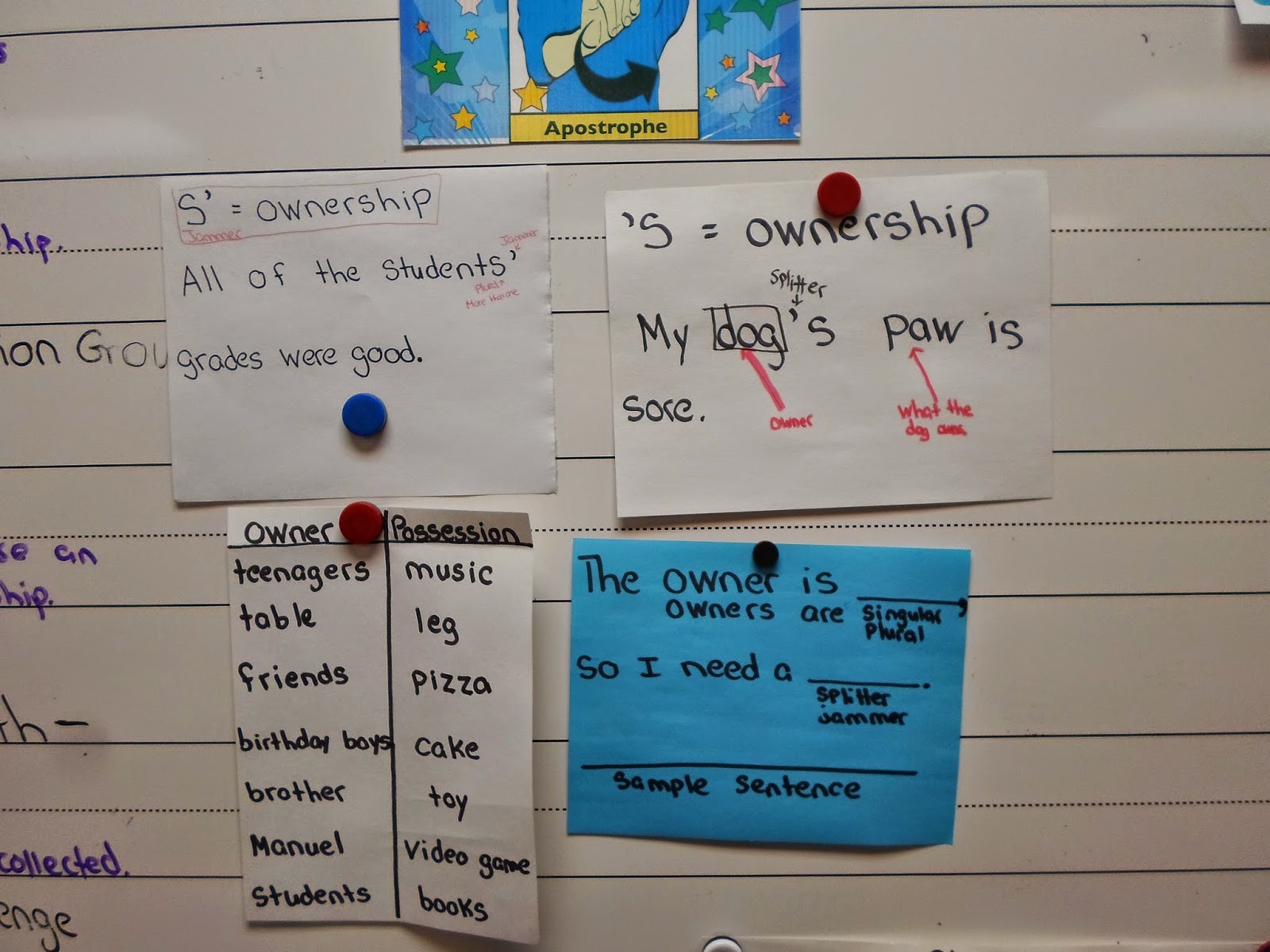
1.  Our focus skill this week in both reading and writing was possessive nouns.  In the past this has always been a challenge to teach and not something that I looked forward to.  This year, however, was very different.  Not only was it a lot of fun to teach, but my students all quickly and easily caught on to how to use apostrophes to make nouns plural.  I firmly believe that this was mainly due to the WBT way of introducing possessive nouns:  splitters and jammers.  

A splitter is the WBT name for an apostrophe "s" that is used with a singular noun or an irregular plural noun, such as children.  I explained to the class that the splitter (the apostrophe) splits the owner from the "s".  I called the "s" the "badge of ownership" and used the gesture of pointing a thumb on each hand to the front of my shirt.  I would box the noun to show the owner and then talk about how the splitter split the owner and the badge of ownership.  During writing we played the complexor Game. (More information on the Complexor game can be found in other blog posts or on the WBT website under free downloads/The Writing Game.)This gave students many opportunities to orally write sentences with apostrophe s's.  They then wrote the sentences that they had created in their writing notebooks.

A jammer is an apostrophe that follows a plural noun which ends in "s".  I explained to my students that the jammer jams the "s" into the noun, making it plural.  The jammer becomes the "badge of ownership".  The concept of the "badge of ownership really helped my kids to remember to write the apostrophe after the "s".  The kids simply learned that there is always an apostrophe after a jammer, because that is how you show ownership.  We also played the Complexor game with plural possessives and wrote the sentences created in our writing notebooks.

After studying splitters and jammers separately, we combined them together and students had to determine when to use a splitter and when to use a jammer.  This is what the board looked like for that lesson:
                                                             

You will notice the apostrophe Brainie at the top of the board.  We obviously focused on this Brainie for the entire week.  Under that you will see two anchor charts that I created, one for singular possessives and one for plural possessives.  On the day of this lesson I added the list of owners and possessions, as well as the sentence frames.  Using Teach Okay and High Five Switch, students took turns sharing with their partners whether or not the owner was singular or plural and whether they needed to use a splitter or a jammer.  They then had to create a sentence using the owner and the possession, in which they used the apostrophe Brainie.  After students had time to work on this with their partners, they shared with the class using High Five Teach.  I was amazed at how well they had caught on.  Even my lowest students were able to explain when to use a splitter and when to use a jammer.  I will never teach possessive nouns any other way,


2.  Our phonics skill for the week was creating plurals with nouns that end in "s".  In the past I have always taught this in the form of a year.  This fit perfectly with WBT.  Students still learned the cheer, but they learned it using Mirror Words and Practiced it using Teach Okay.  We call it the "Five Finger Rule" cheer.  The cheer goes like this:  If a word ends in s, x, z, sh, ch (hold up one finger for each), you gotta (bend left arm in front of chest with had in a fist.) add (Do the same with right arm.) "es" (Very slightly raise fists on both hands.), yes!  (Jump in the air and bring bent arms out straight.)  The kids have so much fun doing this cheer, and by the end of the week everyone knows when to use an "es" to make a word plural.

3.  We did two Genius Ladders last week that were both very challenging, but the students did a great job on them.  They both focused on possessive nouns, but on one there was an apostrophe "s", and on the other there was an "s" apostrophe.  On both I included a dependent clause telling when.  This is our newest extender.  We have been working on it for about three weeks.  Both ladders were very challenging.  The sentences were quite long and there were a lot of Brainies in them, but the kids did a great job!  I was very proud of them.

4.  For red/green writing I asked the students to write a five paragraph essay on what they did over spring break.  I am happy to report that fifteen out of my seventeen students can now successfully write  a five paragraph essay.  My biggest celebration is that one of my two lowest students, a special ed. child who began the year as a non-reader, was able to write for the very first time (with a little assistance) his very first five paragraph essay.  The class celebrated with him as he earned a Super Improver Star.  I also had a number of students use possessive nouns correctly in their writing.  They were all quick to point this out to me, because they were all looking for a Super Improver Star.  I am happy to say that they each earned one.

5.  This week I introduced students to the Brain Tree.  If you are unfamiliar with the Brain Tree, that is because it is the newest WBT technique, hot off the presses just a few weeks ago.  The concept is simple.  Students score themselves from a 1-5 on different WBT techniques that they are using in the classroom.  An analogy is made to an Oak tree.  A one is an acorn, all the way up to a five, which is a mighty towering oak tree with many acorns.  Points are considered leaves, and each week scores are added together to get a total number of leaves for the week.  The goal is for students to beat their previous week's score.  At our school we are having a little friendly competition among participating classes.  Everyone who is doing the Brain Tree has placed one on their door, with their scores.  This will allow other classes to see these scores and try to beat them.  

This was our first week using the Brain Tree, so I wasn't sure how my students would respond to it or how they would do with scoring themselves.  I was very pleasantly surprised.  They caught on to the concept very quickly, and when it came time to give themselves a score, I was amazed at how honest and accurate they were.  The Brain Tree is definitely a great tool  to motivate students.  I am excited to see how they progress each week.  They have set a goal for themselves to have a perfect score (a five in each area) by the end of the year.  That sounds like teacher heaven to me.  We'll see how it goes.  

If you are interested in using the Brain Tree in your room, I have inserted a link with directions and the chart.  I blew my chart up using the poster maker and added pictures of the five different stages in an Oak Tree's development.  Here is the link:


6.  One of my students came up with an idea that we tried, and it has really worked well.  Whenever I ask my students to share with each other using either High Five Teach or Uh/Oh Switch, the student who is sharing stands.  This works really well when the students are at their seats, but when they are seated on the floor in the meeting area, I have told my students not to stand.  One day during the week we were in the meeting area about to use High Five Teach, when one of my students raised her hand and suggested that the student sharing do so while on his/her knees.  I wasn't sure how this would work, but I said that we would give it a try.  It has been great.  The students love it, and it allows them to move a little, even if it is just a change of position, while they are on the floor.


7.  We have been working really hard in reading on two things:  paraphrasing and remembering detail adders.  I have spoken to my students about the need to stick the detail adders in their minds and have used the analogy of velcro to help students get that visual image.  We have also talked about the importance of sticking the first and the last detail adder because if we do that, the ones in the middle are easier for our brains to remember.  This lends itself to paraphrasing because if students are able to stick the details in their brains, they will easily be able to paraphrase what they are reading.  We have been practicing this in reading groups, but I decided to see how it would work as part of the Crazy Professor Game.  (This is another WBT game that can be found on the WBT website under free downloads.)  I gave students a fiction passage entitled The Difficult Assignment.  We read the first paragraph using Mirror Words.  I then asked the students to read the paragraph on their own using their Brainies and their gestures, but I also gave them the goal of making sure that they stuck the first and the last detail adders in their minds, to help them with the middle ones.  We even started calling this a detail adder sandwich.  Students then used Uh Oh Switch to paraphrase that first paragraph with their partners.  We repeated this process with each paragraph.  I am happy to report that even my lowest students were able to paraphrase.  Next time we are going to try this with a non-fiction text.


So, there you have it.  Those are the highlights of the week.  I hope that the ideas and experiences that I have shared in this blog will inspire you.  Here's to more week's just like this one!

Thursday, April 9, 2015

The Victory Line

When Coach B. first introduced us all to the Scoreboard Version 2.0 back in the fall, I immediately began using it in my classroom.  Since then, I have been sharing with all of you my class's progression through the scoreboard game.  Each level has definitely brought with it a new degree of excitement, energy, and motivation.  A couple of weeks ago  my class finally reached the level that I have been anticipating the most - The Victory Line - and I have to say that it has been everything that I had hoped it would be.

Before I get into The Victory Line, I would first like to recap for those of you who are not familiar with it, how the Scoreboard Version 2.0 works.  It works very similar to the basic scoreboard, which is basically a two column grid drawn on your whiteboard.  A smilie face is drawn on one side and a frownie face is drawn on the other side.  When the class, or even a few students, performs well, the class is told what they did (ex. Great diamond eyes and folded hands.) and asked for a "mighty oh, yeah".  Students will quickly clap their hands together and say, "Oh, yeah!"  While they do this, they are given one tally mark on the smiley face side of the scoreboard.  On the other hand, if the class does not perform well, they are briefly told what they did (ex.  Too slow.) and asked for a "moaner groan".  Students will quickly shrug their shoulders and groan.  A tally mark is then placed on the frownie face side of the scoreboard.  It is important to note that children can be singled out for positive choices (smilies), but never should a student or group of students be singled out for negative choices (frownies).  When using the scoreboard the + - 3 rule should always be followed.  This means that smilies and frownies should always be within three of each other.  As coach B. says, "If you reward too much, the students become lackadaisical.  If you penalize too much, the students will become resentful."  This is why the +-3 rule is in place.

The main difference is that with the 2.0 version students progress through ten different levels, beginning with Base Camp.  Each level is slightly different.  When students have earned ten wins at one level, they then move on to the next level.  My students began at Base Camp in the fall, but they have now made it to level five, The Victory Line.  To understand the power of the Victory Line, I first need to back up one level and talk about level four, NO Traitors.

Level four is when the competition becomes between the boys and the girls.  It was a very exciting time in our classroom.  There was a lot of "funtricity" in the air, as students worked together to earn a victory for their team.  It came at the perfect time of the year.  Spring break was quickly approaching and it was time to shake things up a little.  No Traitors did just that.  The best part, however, was that a couple of my boys who are in special education began consistently making gestures.  This is something that we  had been working on all year.  They would do so sporadically, but not on a consistent basis.  It wasn't that they weren't paying attention to what we were doing, they just weren't comfortable with the gestures.  No Traitors changed all of this.  As soon as I told the students that I was going to be looking for who did the best gestures, the boys or the girls, these couple of boys stepped up to the plate and began gesturing beautifully.  I was amazed!  They were determined that their team was going to win and they were going to do their part.

The Victory Line took No Traitors to the next level.  As the students got closer to ten wins at the No Traitor level (A win is when the boys and girls combined get more smilies than frownies.), I began to really promote the next level.  I told students that the boys and girls would still be competing against each other, but there was a special prize to be won at this level.  The class could hardly wait to level up.  They worked hard, and when they did, I explained to them the prize.  The winners (boys or girls) would get to line up first all day.  So if the boys won on Monday, then on Tuesday they would get to line up first for the entire day.  They loved it!  This new level brought a newness to the boy girl competition, keeping it fresh and exciting for the students.

Next up is blue dubs.  At this level I will be giving blue tally marks for certain things, like making good gestures.  The secret is that the blue tally marks will count as double.  The competition will still be between the boys and the girls, and the winners will still get to line up first.  The Blue Dubs will just continue to build on what has already been a huge success.

If you have not tried using a scoreboard in your classroom, I would highly encourage you to do so.  It is very easy to implement, will not cost you any money, and will motivate your students and keep them motivated throughout the school year.

Thursday, February 19, 2015

Practice Cards

Over the course of this school year I have had many teachers come to me in frustration because they had some challenging students in their classrooms and the basic scoreboard was not working for those students.  This is when I would introduce them to Practice Cards.  Practice Cards are considered to be level two of the Scoreboard Game and are designed to help you reach those students that Coach B. has named our "Beloved Rascals".  They are the kids who need a little extra motivation to follow the classroom rules.  In this post I would like to share with you what the practice cards are and how to implement them in your own classroom.

You will need to do a little bit of advance preparation in order to get started with practice cards.  The first thing you will need is a pocket chart similar to the ones teachers use for red/green cards.  However, you will be using yours for the practice cards.  Assign each student a pocket.  You will then need to run off, and I would suggest laminate, your practice cards.  (I will explain exactly what these cards are in just a moment.)  The good news is that the cards are already made for you.  You can find them under free downloads on the Whole Brain Teaching website,  The address is www.wholebrainteaching.com.  Just remember that you need to register on the site in order to have access to the free downloads.  You will also need a letter to send home to parents letting them know which rule their children have broken.  Finally, you will need a letter explaining this management system to the parents.

Now let's look at how practice cards work.  A practice card is a small card with one of the five classroom rules on it.  The rules are as follows:

1.  Follow directions quickly.
2.  Raise your hand for permission to speak.
3.  Raise your hand for permission to leave your seat.
4.  Make smart choices.
5.  Keep your dear teacher happy.

If a child is having difficulty follow a particular rule, the teacher places the practice card for that particular rule in the child's pocket on the pocket chart.  The child then must come in at recess for rule practice.  This is not intended to be a punishment for the child and should not be presented as if it is.  Instead, it is an opportunity for the child to practice the rule that he is having difficulty with so that he will remember to follow it in the future.  To practice the rule the child simply repeats the rule with its corresponding gesture over and over for a specific length of time.  Here, however, is the great part about this.  You let the child decide how long he thinks that he needs to practice the rule in order to remember it and be able to follow it.  It could be as short as one minute or as long as four minutes.  It is not about how long the child practices the rule.  It is about communicating the importance of following the rules and letting the child know that you are there to help him/her be successful in this.

The child is also given a note to take home to his parents letting them know the rule that he needs practice following and asking them to have the child practice the rule at home.  The note must be signed and returned the next day.  The practice card can then be taken out of the child's pocket.  Sometimes you will have a situation in which letters are never returned.  When this happens, you can ask another staff member to do rule practice with the student and sign the letter.

Since the goal is not to punish but to help students follow the rules, practice cards can be covered with purple cards, which means that the student does not have to come in for rule practice.  Here is how the purple cards work.  Let's say that you have a student that began the day blurting out.  He was not following rule two, so you put a rule two practice card in his pocket.  After he got that card, you could see that the child was working really hard at following rule two and did not blurt out the rest of the morning.  You could then choose to cover his practice card with a purple card.  This shows the student that you recognize and appreciate the effort he is making at following rule two; therefore, he no longer needs to come in for rule practice and will not need to take a note home.

If you have a child who consistently is breaking a rule, even after coming in for rule practice and sending letters home, it is time to give that child a star card.  I just take a note card and write the rule that the child is having trouble following in the center of the card.  I then ask the child to make a tally mark every time that he is following the rule.  When the child has demonstrated that he can follow the rule, he earns a Super Improver Star. (See my post on the Super Improver Wall.)  It is not about the number of tallies that a child makes on his card.  It is about using positive reinforcement to help a child change a behavior.

Practice Cards should not be started on day one of school.  Students need time to learn and understand the rules first.  At the beginning of the year when I student is having trouble following a rule I keep him in for a talk about the rule he broke and what he can do that would help him follow that rule.  I usually ask if the student would like a short talk, long talk, or no talk.  If they choose no talk they must tell me the rule that they broke and what they will do in the future to make better choices.  In a short talk I share this information with them.  I have not yet had a student choose a long talk, but I always leave it as an option.

Some teachers try not to start practice cards until the end of October or even Thanksgiving.  However, if you have a very challenging class, you might find that you need to start them sooner.  I have been very blessed this year.  For the first time ever, I do not have any real challenging kids; therefore, I have not had to implement practice cards.  I do, however, have them ready for when the need arises.  What I love about using the Whole Brain Teaching management system is that you have all of the tools that you need to work with challenging students, but you only pull them out when you need them.  Every class is different, so each year the tools that you use will be different as well.

For those of you who feel like the practice cards would benefit your students, I am sharing with  you the letter that I had created to send home for when I do decide that practice cards are necessary.  Please feel free to use it with your students

.https://www.dropbox.com/s/3pkdnnkctortbvu/Parent%20Letter%5B1%5D.doc?dl=0

Please note that there are additional strategies beyond the practice cards that you can use with your most challenging "beloved rascals".  You can find these techniques on the Whole Brain Teaching web site on the drop down menu under levels.  I would also encourage you to watch Coach B.'s webcasr called "Reforming Challenging Kids".  It can be found in the video library.  Go to  Goodies on the drop down menu and click on WBT tv.

I hope that the information that I shared with you will help you in working with your "Beloved Rascals".


Thursday, January 22, 2015

The Scoreboard Version 2.0 Continued

Let me begin by giving you a recap of the basic scoreboard:

The Scoreboard has often been referred to as the motivator.  It is a reward system that replaces team points, clip charts, cards, names on the board etc.  It is easy to implement; there is student buy-in and participation; and students are never singled out for wrong choices.  To get started all you need to do is draw a two column grid on your whiteboard.  On one side draw a smiley face and on the other side draw a frownie face.  When the class, or even a few students, performs well, briefly tell the class what they did (ex. Great diamond eyes and folded hands.) and ask for a "mighty oh, yeah".  Students will quickly clap their hands together and say, "Oh, yeah!"  While they do this, you will make one tally mark on the smiley face side of the scoreboard.  On the other hand, if the class does not perform well, you will briefly tell the class what they did (ex.  Too slow.) and ask for a "moaner groan".  Students will quickly shrug their shoulders and groan.  You will then place a tally mark on the frownie face side of the scoreboard.  It is important to note that children can be singled out for positive choices (smilies), but never should a student or group of students be singled out for negative choices (frownies).  When using the scoreboard always follow the + - 3 rule.  These means that smilies and frownies should always be within three of each other.  As coach B. says, "If you reward too much, the students become lackadaisical.  If you penalize too much, the students will become resentful."  This is why the +-3 rule is in place.  The reward can simply be the students knowing that they beat the teacher.  Other options are an extra minute of recess, one less homework problem, Mind Soccer minutes, or a one minute dance party.

Last fall Coach B. introduced us to the latest version of the scoreboard, known as the Scoreboard 2.0, or the Video Game Scoreboard.  It is referred to as the video game scoreboard, because students advance through ten different levels, similar to the way you would move through levels in a video game.  Each level has its own name and brings with it its own set of challenges and rewards.  Last time I shared with you about the scoreboard our class had just started using it.  We were at level one, which is called "Base Camp".  My students have since progressed to level three, which is the Double Bonus level.  The concept of a bonus was first introduced in level two, "Ruleville".  A bonus is a focus on a specific rule or behavior that you want to reinforce in the classroom.  For example, if your students have trouble with Rule Two, "Raise your hand for permission to speak." then you might make Rule Two your bonus.  The bonus is listed separately on the Scoreboard, because it is a behavior that you will be watching specifically for.  When students are caught following this behavior they receive bonus points that count toward their overall score.

Level Three is known as the "Double Bonus".  At this level students are given not just one, but two bonus behaviors to work on.  Coach B. also provided another option at this level.  You could choose to say that all we are working on are the bonus behaviors.  These would then be the only behaviors that you would score for.  I liked that idea.  Overall I have a well-behaved class with no serious behavior issues.  I thought it would be fun and very helpful to focus on two behaviors that can always use a little fine tuning:  Diamond Eyes/folded hands and gestures/Brainies.  Below is what my level three scoreboard looked like when we began.


So far level three has been very successful.  You will notice the numbers one through ten at the top of the board.  I put this there to keep track of the students' wins.  It takes ten wins to move up to the next level.  At the time I took this picture it was the end of day one at level three, and as you can see, the students won.  They have been very excited about this level, and I have definitely noticed an improvement in how quickly students look at me and fold their hands.  I have also noticed that some of my lower babies are trying a lot harder to use Brainies and gestures.  I think that having just those two things to focus on has made a huge difference.  I am really enjoying this level.

I am also looking forward to level four.  It is called "No Traitors!" and looks to be a lot of fun.  At this level the boys compete against the girls and there are no bonuses.  A traitor is someone who scores for the other side, but you would never mention them by name.  Both the boys and the girls earn smilies and frownies.  The winner (boys or girls) is determined by who has the most smilies.  I have decided that the winning side will get to line up first the next day.  This should generate a lot of enthusiasm.  A class win occurs when both the boys and the girls have more positive points (smilies) than negative points (frownies).  I am really excited about this level and so are my students.  I have hinted to them that something really big is going to happen at level four, but I won't tell them what.  As a result, they are even more motivated to get past level three.

If you would like to learn more about all of the levels, then just go to www.wholebrainteaching.com.  From there go to the drop down menu at the top of the page and click on "Goodies".  The first choice under "goodies" is "wbt tv".  When the page opens scroll down and you will find a video library of webcasts by Coach B.  The Scoreboard is webcast 584.  While there, please be sure to scroll through all of the webcasts in the library.  There you will find a wealth of information on Whole Brain Teaching.


Friday, November 14, 2014

The Scoreboard Version 2.0

The Scoreboard has often been referred to as the motivator.  It is a reward system that replaces team points, clip charts, cards, names on the board etc.  It is easy to implement; there is student buy-in and participation; and students are never singled out for wrong choices.  To get started all you need to do is draw a two column grid on your whiteboard.  On one side draw a smiley face and on the other side draw a frownie face.  When the class, or even a few students, performs well, briefly tell the class what they did (ex. Great diamond eyes and folded hands.) and ask for a "mighty oh, yeah".  Students will quickly clap their hands together and say, "Oh, yeah!"  While they do this, you will make one tally mark on the smiley face side of the scoreboard.  On the other hand, if the class does not perform well, you will briefly tell the class what they did (ex.  Too slow.) and ask for a "moaner groan".  Students will quickly shrug their shoulders and groan.  You will then place a tally mark on the frownie face side of the scoreboard.  It is important to note that children can be singled out for positive choices (smilies), but never should a student or group of students be singled out for negative choices (frownies).  When using the scoreboard always follow the + - 3 rule.  This means that smilies and frownies should always be within three of each other.  As coach B. says, "If you reward too much, the students become lackadaisical.  If you penalize too much, the students will become resentful."  This is why the +-3 rule is in place.  The reward can simply be the students knowing that they beat the teacher.  Other options are an extra minute of recess, one less homework problem, Mind Soccer minutes, or a one minute dance party.

I began the year using this basic scoreboard, and it has been very successful. I think it has worked so well because it is simple and motivating.  Students love the "mighty oh yeahs".  They have fun counting the tallies on each side and working hard to make sure that they do end the day with more smilies than frownies.  I see the value of the + - 3 rule, because a close score is part of the fun.  I compare it to a ball game.  When the game is a blowout, it is not as interesting.  It is the close score that keeps the spectators' attention.  The same philosophy applies to the scoreboard.  Without a doubt, it has been the best management tool that I have ever found.

There are a number of variations to the basic scoreboard that are designed to keep the scoreboard fresh and motivating.  These variations can be found in Coach B.'s book Whole Brain Teaching for Challenging Kids.  However, the latest and best version of the scoreboard just came out.  Coach B. has labeled it "The Scoreboard version 2.0".  It is also known as the Video Game Scoreboard.  The premise behind this score board is very simple.  It is played like a video game with ten different levels.  Each level has its own name and a unique set of challenges.  Bonuses are attached to each level, beginning with level two.  The first level is called Base Camp.  This level is designed to introduce the students to the scoreboard.  Students will earn smilies when they perform like students in the grade two years above their grade.  They earn frownies when they perform like students in the grade two years below their grade.  So in my room students earn smilies for performing like fourth graders and frownies for performing like kindergartners.  This is a very important part of the scoreboard, because it serves a dual purpose:  it provides a built in structure for practicing the rules and a motivator for students to follow the rules.  Let me explain:

When teaching students a new rule or procedure, wrong way/right way practice should always be used.  During wrong way practice students are asked to model the rule the wrong way.  In my case, I would ask my class to show me what it would look like in a kindergarten classroom.  Students demonstrate this and are praised for doing such a good job of showing me what kindergartners would look like.  We then talk about what the rule or procedure would look like in a fourth grade classroom.  Students would be asked to model what it would look like and would be praised for doing it like fourth graders.  The students are given the goal of always following the rule or performing the procedure like fourth graders would.  This is where the scoreboard comes in.  When students perform a rule or a procedure like a kindergartner, the tally goes on the kindergarten (frownie) side of the scoreboard.  When they perform it like a fourth grader, the tally goes on the fourth grade (smilie) side of the scoreboard.  Since kids always want to be perceived as older than they really are, they will perform at the higher level.

Level one also has a wildcard, if you choose to use it.  Instead of using smilies and frownies, you can name your levels and change the sound effects that students use when earning a tally.  For example, you might use "Captain" and "Crew" and change your sound effects to "Yo ho ho" and "Arg".  Another idea that works well for this time of year is "Farmer" and "Turkey".  Your sound effects could be "Yum Yum" and "Gobble Gobble".  My plan is to throw in a Wild Card at level two, but for level one, I am going to stick with smilies and frownies.

Advancing to the next level is easy.  It takes ten wins to advance to the next level.  A win is simply earning in one day more positive marks than negative marks.  I have chosen to place ten numbers at the top of my scoreboard and mark off one number with each win.  When all ten numbers are marked off, the class will advance to the next level.  I just began the Video Game Scoreboard this week.  My kids love it.  After all, what kid does not love video games.  Below is a picture of what my scoreboard looks like.


You will notice at the bottom that I did choose to keep "Beat the Clock".  I use this for lining up and passing out papers.  I simply count how long it takes for students to either line up or pass out papers, and I write that number down on the scoreboard.  The next time they try and beat that time.  If they do it is a positive mark.  If they don't it is a negative mark.  It is super simple and the kids love it.

As I already mentioned, there are ten levels to the scoreboard.  I have only talked about the first, because this is as far as my class has got.  Throughout the year as my class moves through the levels, I will share with you more about this exciting new scoreboard.  If you are ready to learn more about all of the levels, then just go to www.wholebrainteaching.com.  From there go to the drop down menu at the top of the page and click on "Goodies".  The first choice under "goodies" is "wbt tv".  When the page opens scroll down and you will find a video library of webcasts by Coach B.  The Scoreboard is webcast 584.  While there, please be sure to scroll through all of the webcasts in the library.  There you will find a wealth of information on Whole Brain Teaching.


Tuesday, September 16, 2014

Ready to Listen

This post is going to be short and sweet.  I just wanted to quickly share with you a trick that I tried that has really helped ensure that all of my students are ready to listen.  When I use "Class Yes" with my students, the attention getting signal used in Whole Brain Teaching, I expect all of my students to look at me and fold their hands.  This works well most of the time, especially if the students are not writing or working with something at their desk.  However, it doesn't work as well when they are writing or working with manipulatives or their white boards.  I have found that even when they answer "yes" and look at me, some will try to finish what they are doing, rather than follow directions quickly (rule one), by immediately stopping what they are doing and folding their hands.

We talked about this, practiced this, and even made it a team goal on the Super Improvers Wall, but there was still that group of students who did not immediately stop what they were doing and fold their hands.  My solution was "the hot potato".  I told them that when I say "class" anything that they are holding in their hands instantly becomes a hot potato, and they must drop it.  It worked like a charm.  Now they instantly stop what they are doing, fold their hands, and look at me.  We are now earning our team improver stars in this area easily.

To sum up, (Yes, we have been working on concluders this week.) if you are having trouble getting your students to instantly stop what they are doing and fold their hands, try the hot potato technique.  As I have learned, it truly works!