Showing posts with label Oral Writing. Show all posts

Thursday, April 16, 2015

Reflections on an Awesome Week!

Last week was an awesome week!  If you were to ask me why, I don't think that I could name just one thing.  Instead, I would have to say that it was a combination of many things, all of which were WBT related.  I would like to share with you my list of what made last week one of my favorite teaching weeks of the year.

1.  Our focus skill this week in both reading and writing was possessive nouns.  In the past this has always been a challenge to teach and not something that I looked forward to.  This year, however, was very different.  Not only was it a lot of fun to teach, but my students all quickly and easily caught on to how to use apostrophes to make nouns plural.  I firmly believe that this was mainly due to the WBT way of introducing possessive nouns:  splitters and jammers.  

A splitter is the WBT name for an apostrophe "s" that is used with a singular noun or an irregular plural noun, such as children.  I explained to the class that the splitter (the apostrophe) splits the owner from the "s".  I called the "s" the "badge of ownership" and used the gesture of pointing a thumb on each hand to the front of my shirt.  I would box the noun to show the owner and then talk about how the splitter split the owner and the badge of ownership.  During writing we played the complexor Game. (More information on the Complexor game can be found in other blog posts or on the WBT website under free downloads/The Writing Game.)This gave students many opportunities to orally write sentences with apostrophe s's.  They then wrote the sentences that they had created in their writing notebooks.

A jammer is an apostrophe that follows a plural noun which ends in "s".  I explained to my students that the jammer jams the "s" into the noun, making it plural.  The jammer becomes the "badge of ownership".  The concept of the "badge of ownership really helped my kids to remember to write the apostrophe after the "s".  The kids simply learned that there is always an apostrophe after a jammer, because that is how you show ownership.  We also played the Complexor game with plural possessives and wrote the sentences created in our writing notebooks.

After studying splitters and jammers separately, we combined them together and students had to determine when to use a splitter and when to use a jammer.  This is what the board looked like for that lesson:
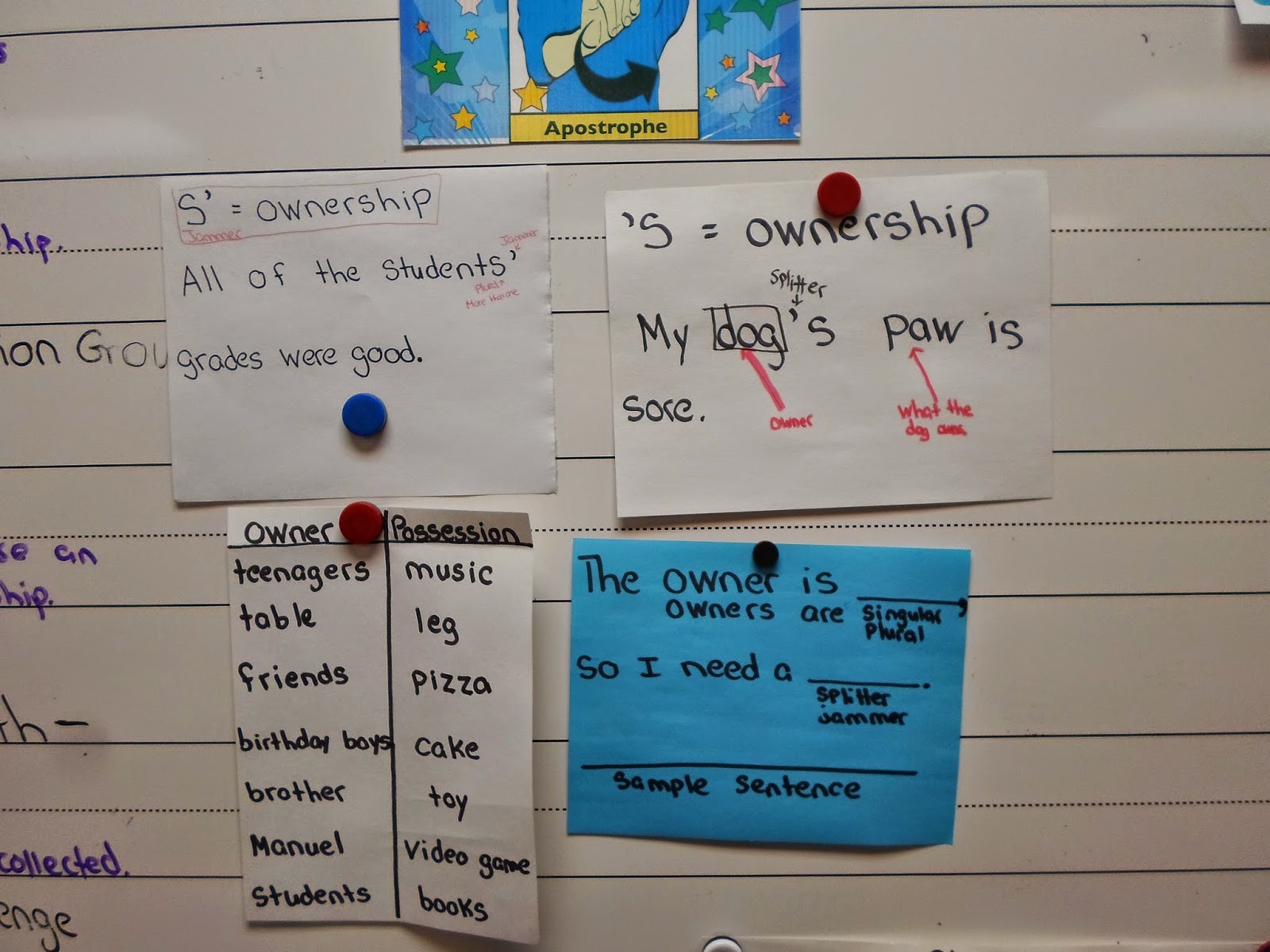
                                                             

You will notice the apostrophe Brainie at the top of the board.  We obviously focused on this Brainie for the entire week.  Under that you will see two anchor charts that I created, one for singular possessives and one for plural possessives.  On the day of this lesson I added the list of owners and possessions, as well as the sentence frames.  Using Teach Okay and High Five Switch, students took turns sharing with their partners whether or not the owner was singular or plural and whether they needed to use a splitter or a jammer.  They then had to create a sentence using the owner and the possession, in which they used the apostrophe Brainie.  After students had time to work on this with their partners, they shared with the class using High Five Teach.  I was amazed at how well they had caught on.  Even my lowest students were able to explain when to use a splitter and when to use a jammer.  I will never teach possessive nouns any other way,


2.  Our phonics skill for the week was creating plurals with nouns that end in "s".  In the past I have always taught this in the form of a year.  This fit perfectly with WBT.  Students still learned the cheer, but they learned it using Mirror Words and Practiced it using Teach Okay.  We call it the "Five Finger Rule" cheer.  The cheer goes like this:  If a word ends in s, x, z, sh, ch (hold up one finger for each), you gotta (bend left arm in front of chest with had in a fist.) add (Do the same with right arm.) "es" (Very slightly raise fists on both hands.), yes!  (Jump in the air and bring bent arms out straight.)  The kids have so much fun doing this cheer, and by the end of the week everyone knows when to use an "es" to make a word plural.

3.  We did two Genius Ladders last week that were both very challenging, but the students did a great job on them.  They both focused on possessive nouns, but on one there was an apostrophe "s", and on the other there was an "s" apostrophe.  On both I included a dependent clause telling when.  This is our newest extender.  We have been working on it for about three weeks.  Both ladders were very challenging.  The sentences were quite long and there were a lot of Brainies in them, but the kids did a great job!  I was very proud of them.

4.  For red/green writing I asked the students to write a five paragraph essay on what they did over spring break.  I am happy to report that fifteen out of my seventeen students can now successfully write  a five paragraph essay.  My biggest celebration is that one of my two lowest students, a special ed. child who began the year as a non-reader, was able to write for the very first time (with a little assistance) his very first five paragraph essay.  The class celebrated with him as he earned a Super Improver Star.  I also had a number of students use possessive nouns correctly in their writing.  They were all quick to point this out to me, because they were all looking for a Super Improver Star.  I am happy to say that they each earned one.

5.  This week I introduced students to the Brain Tree.  If you are unfamiliar with the Brain Tree, that is because it is the newest WBT technique, hot off the presses just a few weeks ago.  The concept is simple.  Students score themselves from a 1-5 on different WBT techniques that they are using in the classroom.  An analogy is made to an Oak tree.  A one is an acorn, all the way up to a five, which is a mighty towering oak tree with many acorns.  Points are considered leaves, and each week scores are added together to get a total number of leaves for the week.  The goal is for students to beat their previous week's score.  At our school we are having a little friendly competition among participating classes.  Everyone who is doing the Brain Tree has placed one on their door, with their scores.  This will allow other classes to see these scores and try to beat them.  

This was our first week using the Brain Tree, so I wasn't sure how my students would respond to it or how they would do with scoring themselves.  I was very pleasantly surprised.  They caught on to the concept very quickly, and when it came time to give themselves a score, I was amazed at how honest and accurate they were.  The Brain Tree is definitely a great tool  to motivate students.  I am excited to see how they progress each week.  They have set a goal for themselves to have a perfect score (a five in each area) by the end of the year.  That sounds like teacher heaven to me.  We'll see how it goes.  

If you are interested in using the Brain Tree in your room, I have inserted a link with directions and the chart.  I blew my chart up using the poster maker and added pictures of the five different stages in an Oak Tree's development.  Here is the link:


6.  One of my students came up with an idea that we tried, and it has really worked well.  Whenever I ask my students to share with each other using either High Five Teach or Uh/Oh Switch, the student who is sharing stands.  This works really well when the students are at their seats, but when they are seated on the floor in the meeting area, I have told my students not to stand.  One day during the week we were in the meeting area about to use High Five Teach, when one of my students raised her hand and suggested that the student sharing do so while on his/her knees.  I wasn't sure how this would work, but I said that we would give it a try.  It has been great.  The students love it, and it allows them to move a little, even if it is just a change of position, while they are on the floor.


7.  We have been working really hard in reading on two things:  paraphrasing and remembering detail adders.  I have spoken to my students about the need to stick the detail adders in their minds and have used the analogy of velcro to help students get that visual image.  We have also talked about the importance of sticking the first and the last detail adder because if we do that, the ones in the middle are easier for our brains to remember.  This lends itself to paraphrasing because if students are able to stick the details in their brains, they will easily be able to paraphrase what they are reading.  We have been practicing this in reading groups, but I decided to see how it would work as part of the Crazy Professor Game.  (This is another WBT game that can be found on the WBT website under free downloads.)  I gave students a fiction passage entitled The Difficult Assignment.  We read the first paragraph using Mirror Words.  I then asked the students to read the paragraph on their own using their Brainies and their gestures, but I also gave them the goal of making sure that they stuck the first and the last detail adders in their minds, to help them with the middle ones.  We even started calling this a detail adder sandwich.  Students then used Uh Oh Switch to paraphrase that first paragraph with their partners.  We repeated this process with each paragraph.  I am happy to report that even my lowest students were able to paraphrase.  Next time we are going to try this with a non-fiction text.


So, there you have it.  Those are the highlights of the week.  I hope that the ideas and experiences that I have shared in this blog will inspire you.  Here's to more week's just like this one!

Thursday, March 26, 2015

Planning

It is really hard to believe that next week is spring break and that I am right at a couple of months short of completing my first full year as a Whole Brain Teacher.  It has been an amazing year!  I have learned so much as an WBT intern.  I am so grateful to Nancy, my mentor, and to Coach B. for all of their help and encouragement.  Over the course of this school year I have written about a variety of techniques, skills, and strategies that you would find in a WBT classroom.  For this blog I have decided to answer a question that a lot of people have asked me this year:  Do you find that planning is easier or harder when you are doing Whole Brain Teaching?

The answer to that question is simple.  It is so much easier!  O.k, to be honest, it was harder in the beginning, but that was because everything was so new to me and I had so much to learn.  It took time to figure out how all of the pieces fit together.  Now, I can honestly say that I spend a lot less time planning than I used to.  I think that this is mainly due to the fact that the structures (The five step lesson, Power pics, The Genius Ladder, Teach/Okay, Mirrors, Red/Green Writing, Brainies,  the use of Sentence Frames etc.) are already there.   I just have to plug my lessons into them.  I have found that with so many tools, I can easily weave instruction of a new concept into multiple parts of my day.

A perfect example of this is a unit that we just completed last week.  Our class spent two weeks learning about Point of View and Dialogue.  The first week I focused on point of view.  The five step lesson format made planning very easy.  I began by creating a Power Pic for point of view.  Deciding on my question and answer was very important, because I knew that it was these two things that would guide my instruction.  Below is my Power Pic:


Question:  What is point of view?
Answer:  Point of view is who is telling the story:  first person, a character; second or third person, the author.
Gestures:  Shrugging shoulders and then holding up one finger at a time for each of the three persons.

I knew that each day that week I would begin with my question and answer.  When thinking about how to expand my lesson, my first step was to create a sentence frame.  I use sentence frames on a regular basis.  They provide a support and structure for my students, especially my ELL students, as they share during Teach Okays and Call-Outs.  I chose the following frame:  This story is being told from ________________.  I know this because ________________.  When planning any lesson I automatically include opportunities for students to prove their answers using a "because clapper".

This led to the question, "What do I expect my students to use for proof?"  I quickly decided to use the WBT concept of "Power Words".  I created an anchor chart with a tree map.  On the tree map I placed my power words for first second and third person, along with my sentence frame.  Below is a picture of it.  This anchor chart stayed in the front of my room and became a reference for my students during the entire unit.  Below is a picture of it.

                   
Once this was done, the rest was very easy.  The main way that I taught the concept was to read short paragraphs and using Teach/Okay ask the students to share from what point of view the text was being told and how they knew.  I would remind them to use the sentence frames on the anchor chart.  For proof they would say things like, "I know this because I heard the Power Words he, she, and their.  For a couple of days I read the same scenarios, but from different points of view.  Students would use these same sentence frames to discover the point of view that the books they were reading were being written from.  At the end of independent reading time, students would first share with their partners using Teach/Okay and then with the class using Call-outs.

The last step of the five step lesson plan is critical thinking.  This is usually done through writing.  During Red/Green writing I gave my students a short story about a cat named Cupcake who ran away from a campground and walked 150 miles to get back home.  The story was told from third person.  I asked my students to rewrite it from first person, the point of view of Cupcake.  We did some oral writing practice first, and then they began.  The students did a really nice job.  Below is one of their stories.


During this first week, something happened that I was hoping for.  I shared a text with quotation marks.  The character speaking used the word "I'.  Some of my students immediately thought that this had to be first person.  This led to the introduction of quotation marks.  It was a perfect lead-in.  In the past I had always struggled with the best way to teach quotes to second graders, but this year it was easy.  I began with the Quotation Mark Brainie.  My students were familiar with it, because I had previously pointed quotes out to them in text and they had used the Braine, but they really did not understand this Brainie.  I decided that the Brainie would serve in a way as my Power Pic.  This led to me deciding upon the following question and answer:

Question:  What are quotation marks?
Answer:  Quotation marks are talking marks.  They go around the exact words that come out of a character's mouth.
Gesture:  The gesture for the quotation mark Brainie.

Over the course of the week I gave students short stories with lots of quotation marks.  We would do what I called the one minute drill.  They had one minute to underline all of the quotes.  (Of course, I first demonstrated how to do this.)  They then had to read the passage with their partner using their gestures and Brainies, with an emphasis on making sure that the quotes were done properly.  (This had also been modeled numerous times.)  I then asked students to tell their partners (Teach/Okay) the point of view that the story was being told from (Students used the sentence frames on the anchor chart.) and then called on a student to share using a Call-Out.  We then focused on the quotes.  Using High Five Switch, the students had to take turns reading the quotes in order and telling who said it and how they knew.  As they shared, they were expected to use their Brainies, especially quotation marks.  I emphasized the comma and using a capital Brainie for the first word at the beginning of a sentence inside of the quotation marks.  Of course I provide them with the following sentence frame:  ______________ said __________________.  I know this because ___________________.  For their proof they usually said something like, "I know this because it said _______ said after the quotation marks."

As I did with point of view, I asked the students to find quotes in the books that they were reading and to share at the end of independent reading time, using the sentence frames that I had provided.

They were doing so well with all of this, that I decided to take quotation marks to a Genius Ladder and see how well they did at it.  Below is the Genius Ladder that I used.


The students had a really good time with the simple sentence that I chose.  At the Genius level students were asked to write a conversation with themselves and their mom.  Most of my students were correctly using quotes, not forgetting the comma before or after the quote, and were capitalizing the first word inside the quotation marks.  This can be attributed to all of the oral writing that they had been doing with quotation marks.  I was really impressed with how well many of them did at changing paragraphs when they changed speakers.  My students were already very familiar with paragraph form and the indent Brainie, so this wasn't that difficult for them.  You may have noticed that at the extender level I introduced my students to the dependent clause.  This is another Brainie that we had not previously talked about.  Prior to this time, they were not ready for it.  They still needed more work on it.  It will definitely be the focus of our next few Genius Ladders, but they are beginning to catch on.  It just amazes me the caliber of writing that you can get from second graders and what they are actually capable of understanding.  Prior to finding a Whole Brain Teaching I would have never imagined that my students would be writing conversations so effortlessly with quotation marks and in paragraph form, nor would I have believed that they would be able to correctly write complex sentences with dependent clauses.

As a side note I wanted to point out that towards the end of this time we began an explanatory text unit in writing.  Right away one of my students raised her hand and said, "We are going to be writing from second person."  It was one of those moments when all I could do was say a quick prayer in my head, thinking God for Whole Brain Teaching.

I hope that you have found this look into my planning process helpful.  Happy teaching!


Thursday, January 15, 2015

Common Core Curriculum and the Genius Ladder

I love the Genius Ladder!  It is one of the core components of the Whole Brain Teaching writing classroom.  If you are not familiar with what the Genius Ladder is or how to use it, please see my post entitled The Genius Ladder before reading any further.  There you will find a full description of what the Genius Ladder is and how to use it within your classroom.  I have been using the Genius ladder faithfully since the second week of school.  I have always chosen the content of my ladder based upon what type of extender I wanted to use.  I began with the because clapper.  From there I moved on to phrases that answered the questions "when" and "where".  Next, it was on to prepositional phrases.  I then taught my class how to form compound sentences.  Most recently, my class learned how to use the conjunction "but".

I could have easily continued making my ladders based upon the type of extender I wanted to use, but recently I decided to try something different.  I decided to build my ladder around our common core content.  With the Common Core, the rigor our curriculum has definitely increased.  Students no longer just need to know the answer.  They also need to be able to explain their reasoning in writing.  I decided that the Genius Ladder would provide the perfect framework for students to do just that. I also made the decision to combine this use of the Genius Ladder with Red/Green Writing.  This made perfect sense to me, since one of the topics that students are encouraged to write about during Red/Green Writing is what they have learned about that day.  The Genius Ladder would simply provide more structure.

The first step was to decide which standard to use first within the ladder.  In math we are learning how to subtract with regrouping to the tens place.  Any second grade teacher who has ever taught their students how to do this knows how challenging this can be.  Students need to understand when and why they take a ten from the tens place and trade it in for ones.  It was upon this premise that I built the day's Genius Ladder.  Below is a picture of what it looked like.


The first level, the Blah level, simply says, "The student traded in a ten for ten ones."  At the spicy level I asked students to think of an adjective to describe a student who knew that he needed to trade in a ten for ten ones.  I used the word smart.  My students came up with a number of adjectives  that included brilliant, brainiac, genius, and bright.  At the extender level I asked my students to use a "because clapper" to provide a reason why a student who need to trade a ten for ten ones.  They answered the question using a "Teach Okay" and then shared with the class using call outs.I then wrote in the Genius Ladder what the students shared.  (Normally, I would already have the extender level of the ladder filled in, but since I wanted the students to provide the reason, I wrote it in the ladder after they came up with it.)

It was now time for the Genius Paragraph, which meant that it was time for the students to do some writing of their own.  First we talked about writing a "detail adder" that began  the "For example" Brainie.  We have used this Brainie a little bit in class, but I wanted to provide students with a more structured opportunity to include it within their writing.  I decided that it fit perfectly with this lesson.  Students then used "High Five Teach" to share examples of times when you would not have enough ones to solve a subtraction problem.  Since students had been orally doing something similar during math time, it wasn't too difficult for most of them to think of examples.  After sharing with their partners, I then asked a few students to share with the class.  What really impressed me was how many students used the "If, ___ then" Brainie in their "detail adder" sentence.  We had done a lot of practice with it previously, and it was great to see that students could apply it to a new situation.

Please note that it is very important that students are provided with many opportunities to write orally before they record their thoughts on paper.  While engaging in this oral writing practice students are using their "Brainies".  (Please see my posts on the Brainies.)  The Brainies do a great job of helping students learn the conventions and grammar of the English language.  I have found that this oral writing practice results in significantly fewer errors when students are ready for paper/pencil writing.

It was then time to write.  Students each have a writing notebook that they do their Red/Green Writing in each day.  Students only had around ten minutes to record their thinking, so I was only asking students to write down their topic sentence and one detail adder.  I walked around the room with my red and green pen making marks on the students' writing. ( If you are not familiar with Red/Green Writing, please see my post on the subject.)  Below is a sample of one of my low/average ELL student's writing.  I took a picture of the page in her notebook that contained her Genius Ladder writing.  What you see below it is the writing that she began the next day during Red/Green Writing.


I was very pleased with how this lesson went.  I am looking forward to finding more ways to use the Genius Ladder to reinforce Common Core concepts in all subject areas.


Friday, December 12, 2014

The Wacky Star Fun Button

This post is all about true confessions.  Below is a picture of my Wacky Star Fun Button.  It has been hanging on my board since the first day of school.  I learned about this button over the summer as I was trying to learn everything I could about WBT.  As soon as I saw it and read about it, I fell in love with it.  The premise is pretty simple.  This button is designed to build student engagement during oral writing.  There are many different ways that the button can be used to accomplish this, but I am going to share with you step by step instructions for the way that I decided to use the Wacky Star Fun Button in my room:


1.  Draw the students' attention to the button.  Keep referring to it as the Wacky Star Fun Button and really hype it up.

2.  Tell the students that something special happens when you push the button, but to find out what that is, they have to build their own star.  Explain that the star is built during oral writing.  (By oral writing, I mean anytime that the students are talking with their partners or to the whole class, using Brainies and Gestures.  In my room this happens all day, not just during writing time.)

3.  Every time students do an exceptional job with their oral writing, give them one side of a star.  I just draw the star as they earn it on the board next to the Wacky Star Fun Button.

4.  When students have earned all five sides (made their own star) tell them that when you push the button something very magical is going to happen.  For as long as your hand is on the button, they will all receive magical powers that will allow them to become any animal that they won't.  However, as soon as your hand leaves the star, the powers go away and the students must immediately become themselves again.  The only rule is that they may not yell.

Keep in mind that at the beginning of this post I said that this is what I had decided to do.  Up until a couple of weeks ago I never did it.  I meant to.  I even had the button written in my lesson plans for the first week of school to remind myself.  However, I kept forgetting.  I would usually remember long after the students had finished their oral writing.  For awhile I kept saying, "I will remember next time."  That, however, never happened.  Eventually I just forgot about it completely.  I guess I was so busy learning so many other WBT things, not to mention the normal beginning of the year stuff, that it just never became a priority.

Fast forward to the beginning of December.  One day as I was looking at my board, my eyes stopped on my Wacky Star Fun Button, and I made up my mind that I was introducing it to my kids on that day.  I have to be honest.  I did not realize how engaging it would really be.  My class has been working really hard at using Brainies and gestures at the same time when they are doing their oral writing.  This is really hard for them.  Almost a third of my class is special education, and it is not easy for them to use Brainies and gestures consistently.  However, when I told them about the button, it was like watching a whole new class.  Suddenly I was seeing big gestures and the Brainies from almost everybody.  It took them less than one day to earn all five parts of their star.

They actually finished their star during math.  I didn't want to stop the flow of the lesson, so I told them that when math was over we would do the Fun Button.  However, by the end of math I had forgotten about this.  My students hadn't.  When the lesson was over, I said to my class, "Do you know what time it is?"  In my mind it was time for red/green writing. (If you are curious about what red/green writing is, check out my blog post on this topic.)  My students, however, knew the correct answer.  They all said in unison, "It is time for the Wacky Star Fun Button!"  It took a total of 20 seconds of class time, (That is how long I left my hand on the button.) but the payoff was huge!  The Wacky Star Fun Button has now become a regular part of our day, and I promise you that I no longer forget about it.

I am considering changing up the reward a bit, because we all know that we need to keep what we are doing in the classroom fresh, in order to keep the students interested.  Instead of just changing into animals, I have been thinking about other things that my students can change into for 20 seconds, like musical instruments or vehicles.  If you have any ideas, I would love to hear them.  Please leave a comment after this post.

Remember, there is no one set way to use this button.  Although originally designed to be used with oral writing, I know that teachers have chosen to use it with other things as well.  It is all about what will work best in your classroom with your students.  I am attaching the download of the button that I got over the summer.  There are instructions attached that are a little different than what I shared with you.  Use these, use my ideas, or come up with your own.  I just challenge you to give the Wacky Star Fun Button a try.  Like me, I promise that you will not be sorry.  https://www.dropbox.com/s/2p5r4sp5a9i2ir1/WackyStarFunButtonWholeBrainTeaching.pdf?dl=0

Thursday, December 4, 2014

A Closer Look at a Writing Lesson

One of the things that I love the best about Whole Brain Teaching is the way that writing is taught. Over the years I have seen and have used so many writing programs and methodologies in which students are given a lot of time to practice writing, but what they are practicing is the wrong way to write.  This revelation did not occur to me until I started teaching writing the Whole Brain way.  In Whole Brain Teaching writing is broken down into its smallest components and taught to the students in such a way that what they are practicing is the correct way to write.  I would like to demonstrate this by sharing with you a lesson that I recently taught on compound sentences and the joining word "but".  I used the WBT 5 step lesson plan and taught this lesson over a period of three days.

If you are not familiar with this format, please see my blog post entitled, "The Five Step Lesson Plan."  Before sharing with you my lesson, there is one thing that I would like to point out.  During the explanation portion of the lesson it is so important that you chunk the information that you are sharing with your students into very small parts.  The longest you should be talking at any one time before asking the students to share with their partners (Teach Okay) is around 30 seconds.  The general rule is that you share information with the students using "Mirror Words" (students repeat your words and copy your gestures) and immediately follow this with "Teach Okay".  (You say, "Teach."  The students respond "Okay."  They then turn quickly to their partners and share what you have just taught them.)  This is not an easy thing to do.  As teachers we are used to talking.  Getting into the habit of chunking your lessons takes time and practice.  This is something that I have recently really been working on.  I found that the best way to make sure you are doing this is to decide in advance at what places in your lesson you are going to have your students do "Teach Okays".  Honestly, when I started teaching this way there were times where I thought that this was impossible.  What I discovered, however, is that when I forced myself to plan a lesson around the idea that I was going to chunk it, my lessons turned out better, and my kids did a much better job of understanding and retaining the information.

In the lesson below I have written all of my "Teach Okays" in red, so that you can more easily see how many small chunks I broke my lesson into.


Question:  "Our question for today is, what is a compound sentence?"  Teach Okay

Answer:  "A compound sentence is two sentences (hold up to fingers) put together to make one sentence (with other hand grasp two fingers and pull them together)."  Teach Okay

Explain:  (Have a compound sentence with the word "but" written on the board.)  "Today they are going to learn how to form a compound sentence using the conjunction "but.  Tell your partner what you are going to be learning today."  Teach Okay  Remind students that "but" is one of our Brainies.  Using "Mirror Words" and "Brainies" read the sentence on the board.  Teach Okay  "Mirror Words.  (use Brainies)  The first sentence is ..."   Teach Okay  "Mirror Words.  (use Brainies)  The second sentence is ..."   Teach Okay  "Mirror Words.  But joins the two sentences together."  Teach Okay


Explain to students that you use the word "but" when you are comparing.  Using the sentence that you have already read, point out to students what you are comparing.  (For example, if your sentence was "Johnny can run fast, but Mark can run faster," you would be comparing how fast Johnny and Mark could run.)  "We are going to read some more sentences together.  It is going to be your job to decide what we are comparing.  Mirror Words.  (Read Sentence using Brainies.)  Teach Okay
Repeat with two to three other sentences.

"This time I am going to give you the first sentence.  It will be the job of you and your partner to finish the compound sentence.  Don't forget your comma and your joining word.  We will be using High Five Teach (In High Five Teach students take turns sharing.  I have taught my students that the person sharing stands up, and the other student must repeat his words and copy his gestures.  This increases student engagement.  When one student is done sharing he high fives his partner and sits down.  His partner then stands up and begins sharing.)  Mirror Words.  (Read sentence using Brainies.)  Teach Okay
Repeat with three to five other sentences.

Next, play the "but" complexor game.  Directions for this game can be found in "The Writing Game".  This is a free download that is available at www.wholebrainteaching.com.  All you have to do to receive the downloads is register on the site.  Once you do they will be available to you on the right side of the screen.  Click on downloads.  Scroll through until you find "The Writing Game".

Please note the number of "Teach Okays" in the explain portion of the lesson.  Depending on how many sentences you choose to do with your students, you could be doing anywhere between eleven and fifteen "Teach Okays".

Test:  It is in this portion of the lesson that we check students' understanding.  "It is time for QT."  (This stands for question time.  The kids will respond "Cutie".  They then put their heads down and lay their hand flat on their desks.)  Ask students the following question:  "Is this sentence correct?"  Have ready a list of sentences to read to the students, all using the word "but".  Make sure that some of the sentences are using "but" correctly, and some are using "but incorrectly.  Students listen to the sentence and respond with either a thumbs up or thumbs down.  This tells you as the classroom teacher who is getting it and who isn't.  This allows you to either go back and reteach or move on.  It also lets you know which of your students you might want to pull for further instruction at a different time.

Critical Thinking:    Guide students orally through the first three rungs of the Genius Ladder (For more information on the Genius Ladder, see my Blog Post on this topic.) using the following sentences:
Blah:  my brother's favorite food is pizza.
Spicy:  My brother's favorite food is hot, cheesy pizza.
Extender:  My brother's favorite food is hot, cheesy pizza, but my favorite food is cold ice cream.
Genius Paragraph:  Students create their own paragraph using the structure of the extender sentence as their topic sentence, but changing the foods and people as they want to.  They must give detail adders and a concluder (concluding sentence).  This is done orally at first, but then the students are asked to put their paragraph into writing.

It is important to note that at every level of the Genius Ladder students are sharing using Teach Okay and Tag Team.  While the students are writing their paragraphs, I walk around the room with my red and green pens to do red/green writing.  If you are unfamiliar with what red/green writing is, please see my blog post on this topic.

I hope that you have found this lesson helpful and that it inspires you to take a closer look at your writing program.


Friday, September 26, 2014

WBT Writing

I chose to write this post in red because red is a color that grabs the attention of others, and it is my hope that this post will grab your attention.  Let me just begin by saying, WBT writing rocks!  We are five weeks into the school year, and I am loving what I am seeing.  If you are considering using some or all of the Whole Brain writing techniques, but are still a little unsure, let me encourage you.  You will be amazed at the results!

It is not easy to let go of what we know and have always believed in.  When I decided to do full WBT implementation this year, that meant letting go of some things that I had always believed in very strongly, like Writers' Workshop.  For 24 years I had either been using or training other teachers in how to use a Writers' Workshop approach.  It was not an easy thing to let go of, but now that we are five weeks into the school year, I can tell you that I do not regret that decision at all.  The truth is that I have never gotten such good results in such a short amount of time.  Since I am no longer doing Writers' Workshop, I can only attribute this success to teaching writing the WBT way!

It is hard to pinpoint one component of the program that makes it so successful.  I see it as a synergistic effect that is achieved when all of the different components are mixed together.  Having said this, however, I do think it starts with a combination of oral writing and the Brainies.  There is such truth in the statement, "If a child can say it, he can write it."  Oral writing teaches kids how to write before they have even picked up a pencil.  The teacher provides students with a framework for oral writing through the use of sentence frames. Sentence frames benefit all students, but with a class composed mostly of ELL students, a third of which are in special education, I find that the sentence frames are especially beneficial.  The Brainies are gestures that accompanies students oral writing.  These gestures remind them to do things like punctuate correctly or indent.

I also love the WBT philosophy that writing should be broken down into its smallest components and these components should be taught individually.  Coach B. uses the analogy of a tennis game.  Before anyone can pick up a racquet and play, he must first learn a backhand, forehand, volley, serve, overhead shot etc.  Writing works the same way, but many times we expect students to write without teaching them the individual components or giving them the structure that they need to become strong writers.  WBT uses complexors and puzzlers to teach these skills and frameworks in a fun game-like format.  You can read more about complexors and puzzlers by going to the Whole Brain Teaching website and downloading the Writing Game.

I also believe that another thing which makes Whole Brain writing so successful is the immediate feedback that students receive through red/green writing.  I am able to provide feedback to all of my class everyday through red/green writing, as opposed to just three or four students each day when I was using a Writers' Workshop model and conferencing with my students individually.  If you would like to know more about what red/green writing is and how to implement it, please see the post that I have written on this subject.

I would like to end by sharing with you the comment that actually inspired this blog post.  I have a student in my class who I will call Tommy.  Tommy is one of my special education students.  He entered my room as a total non-reader and a non-writer.  At the beginning of the year Tommy struggled with writing even a few words.  He felt successful, however, through oral writing.  He could verbalize what he wanted to say and share it with others.  As he has slowly started to read, he has also slowly started to write.  Last Monday for red/green writing I asked students the following question:  What did you do over the weekend?  Their answers became their topic sentences.  Tommy then asked me the question that I will never forget:  "Can we do one of those three zoop (the sound effect for comma) sentences?"  I answered, "You mean a triple whammy sentence.  Of course, you can."  I came back by a few minutes later and he had written the perfect triple whammy sentence, sharing three things that he did over the weekend, and it was punctuated perfectly.  I could share many other stories, but I think that Tommy's does the best job of emphasizing the point that Whole Brain writing truly does work.

My goal in writing this post was not to teach you how to do Whole Brain writing (Which, by the way, would be impossible to do in one post.), but it was to inspire you to consider learning more about it and using some or all of its components in your classroom.  I hope that I have achieved this goal.  Happy writing!

Friday, September 19, 2014

Oral Writing Essay

Our class has been working on oral writing since the first day of school.  However, up until this point, it has just been individual students sharing individual sentences.  I decided that this week it was time to take the plunge and do our first oral writing essay as a class.  I have to be honest.  I was not sure how my class would do with it.  Out of my 18 students, 14 are well below grade level, with 6 of those in special education.  However, I decided that the only way for both my students and myself to learn was to just do it, so we did.

I knew that it would be important for my students to have a model to follow for putting together this essay, so I used the model that I had been teaching my students in writing.  Below is a picture of it that is now hanging up in our writing area.
                                                                         

The go sign was an answer to a question.  This became our topic sentence.  When I introduced this model to my students I placed a rock in each of their pencil boxes and asked the question, "What did Miss Ray give you?"  I then instructed them to look in their pencil boxes for the answer:  Miss Ray gave me a rock.  They now had their topic sentence.  Each star represents an adder.  (This is what Whole Brain Teaching calls a detail.)  Before each adder they had to use a "traffic light" transition word.  They needed a green light transition word before their first adder, a yellow light transition word before their second adder, and a red light transition word before their last adder.  Below is a picture of my traffic light transitions.


The stop sign after the stars represents the students' concluder.  (This is what Whole Brain Teaching calls the concluding sentence.)

This model worked really well and resulted in some great writing!  Since the students knew it so well, I decided that it would provide a great framework for their first oral writing essay.  The topic I chose was the retelling of a passage that we had been working on all week in reading.  It was about a mom and her daughter who made cupcakes together.  The students had read this passage numerous times and had used the "Connect 5W+H" Brainie to both write and answer who, what, when, where, why, and how questions about the passage.

Since it was their first time doing an oral writing essay, they needed some guidance, but I was amazed at how well they did.  The first student was able to tell the topic sentence.  Then it was time for the adders (details).  I wasn't sure how my students would do with remembering in order the important details, but they did really good.  I did not even have to remind them to use transition words.  Each student who shared remembered to use the correct transition word with the comma (zoop), when it was his/her turn.  The funnest part, however, was watching them ask for help.  If a student was not sure what to say next, he would say "help me".  The class would then gather around and give suggestions.  This part was a little shaky.  The kids did not quite understand that they each needed to give their own suggestions, instead of chiming in together and following each other.  I think this happened because my lower students are unsure of themselves, so they followed the lead of my few stronger ones. Since I have so many low students, it sounded like one big chorus.  Come to think of it, that is probably a good thing.  When the student sharing heard an idea that he wanted to use, he used "Class Yes" to have the rest of the class return to their seats, or in this case their spots on the floor. After the third adder, the next student knew that he was to give the concluder (closing sentence).  Once again, I did not have to remind this student, because the model was there for him to follow.

I have to admit that it was a pretty awesome thing to see.  I am looking forward to doing more oral writing essays on a variety of topics.  As my students' writing improves and they get more practice at doing oral writing essays, we should be able to move away from such a strict model.  I am very excited to see the progression.

Tuesday, August 19, 2014

My Writing Program

I love all the components of the WBT writing program.  The more I studied each component, the more excited I became about teaching writing next year.  The question, however, that I kept struggling with was, "How do I put all of these various components together?"  I had the general idea, but I was interested in the nuts and bolts of what writing would look like in my classroom on a day to day basis.  Since I knew that my mind would not rest until I figured it all out, I got to work.  I decided to map out exactly what my first ten days would look like, so that I could get some practice in "putting it all together".  After that I just wanted a general idea of what I would be doing the rest of the year.  You might have already noticed that I am a list maker, so I put these plans in my favorite form:  a list.  Please know that these plans are very tentative and sketchy.  I just feel better having something down on paper.  I would appreciate feedback, especially from any second grade teachers who have already taught WBT writing for a year.

Day One:  Introduce students to oral writing. (Question, Answer, Adders, Concluder will be posted on board.)  Question:  What was the best part about today?  At the end of oral writing students will engage in 10 minute writing.  Teacher will introduce focus skill of neatness and do red/green writing.
Note to self:  At the end of oral writing pique the students' interest in the Wacky Star Fun Button by drawing the first line of a star on the board.

Note:  Oral writing will continue on a daily basis as part of writing lessons or lessons in other subject areas.

Day Two:  Use five step lesson plan to introduce students to what a sentence is.  Have LA pic to display.  Emphasize that from now on we will be answering all questions in complete sentences.  During step three read-aloud short vowel phonic's story.  Ask students to retell the story to their partner using the Two-Finger All-terrain Action Figure with Anti-gravity Boots Brain Toy.  (Poster for each Brain Toy will be displayed in room.)  For step five of the lesson, post the following sentence frame:  The best thing about me is that I am ______________.  (Students are encouraged to add several Adders.)

Oral Writing Sentence Frame:  Today I learned _____________.

Day Three:  Do Coach B's lesson on what a sentence is.  Stop at the end of level one.  (This lesson can be downloaded from the WBT website.  It is under free e-books/common core.)  Also play the Writing Game:  Puzzle one and Complexor "and".

Oral Writing Sentence Frame:  Today I learned ____________ and ____________________.

Day Four:  Using LA Pic, review what a sentence is.  Continue with Coach B's lesson on what a sentence is.  Stop after level two.  Play Writing game using the same puzzle and complexor as yesterday.

Oral Writing Sentence Frame:  The best parts about today were ________________ and ______________.  Students may also choose to use yesterday's sentence frame.

Day Five:  Using LA Pic, review what a sentence is.  Continue with Coach B's lesson through level three.  Teacher will guide students through using each of the following Brain Toys to share with their partner what a sentence is:  Hand Puppets, Air Blackboard, and Props.  Play the Writing Game.  Do Puzzle 3, Subject/Verb Agreement

Oral Writing Sentence Frame:  See yesterday.

Day Six:  Introduce students to the Genius Ladder (first two levels) using the following Blah sentence:  My mom ran.  (There is a free download about the Genius Ladder on the WBT website under free downloads.)
Do Five step lesson on capitalizing the beginning of a sentence.  Display LA Pic.

Oral Writing Sentence Frame:  After school today I am going to ____________ and ______________.

Day Seven:  Begin with the Genius Ladder (first two levels) using the following sentence:  A fireman burped.
Do five step lesson on end marks.  Display the LA Pic.

Oral Writing Sentence Frame:  Students may choose between any of the sentence frames learned with the word "and".

Day Eight:  Play the Writing Game using the Complexor because.  Be sue to teach the "because clapper".  (See the Brainy Game for more information.)
Guide students through level three of the Genius Ladder, using the extender "because".  Students will write as many sentences as they can think of at level three of the Genius Ladder.

Oral Writing Sentence Frame:  See yesterday.

Day Nine:  Begin with the Genius Ladder, orally doing the first three levels with the following sentence:  My sister cried.  Use the extender "because".
Use LA Pics posted on Power Pics Wall to quickly review sentence, capitalizing the first word of a sentence, and end marks.  From Coach B's Common Core Free e-book on what a sentence is, put up the "Cartoon Writing" slide of a cat that says, "In the morning, I _____________."  Guide students through an oral writing lesson with the question being, "What does the cat say that he does in the morning?"  Introduce students to "adders" and the gesture for "adders"  (See the Brainy Game.)  Students follow up the answer to the question with "adders".

Oral Writing Sentence Frame:  Over the weekend I __________ and _________________.  (Today is the first day that students will be required to use adders.  Teacher will not be doing red/green writing today.)

Day Ten:  Look back at the Genius Ladder began yesterday:  My sister cried.  Review what students learned yesterday about adders, and guide students through orally completing the Genius Ladder.  Students write an extender sentence, followed by as many adders as they can.

Note:  During the first ten days of school, I also plan on introducing students to nouns, by playing Electronic Super Speed Grammar daily.

Oral Writing Sentence Frame:  Teacher will give students red and green pens and they will do their own red/green writing on writing done yesterday.

During the remainder of September and the first week of October, my goal is to focus on teaching different extenders, through the use of the Genius Ladder.  I will use the Writing Game to assist me with this.  During oral writing I want to introduce students to Concluders, and teach the the Brainstorming Puzzles in the Writing Game.  I would also like to spend some time on verbs, using Coach B's free Common Core e-book download and Electronic Super Speed Grammar.

Note:  If I feel my students are ready, around the end of September or beginning of October, I would like to introduce students to the "Triple Whammy" sentence.  As the year progresses, I can teach students how to add a detail sentence for each part of the "Whammy" and a Concluder.  This would take place during red/green writing time.  I will create sentence frames to post on the wall that students can use to guide them in how to do "Triple Whammy" writing.

For the remainder of October I will work on explanatory writing.  I do a unit every year in which students write a book on "How to Make an Ice Cream Sundae".  For our Halloween party, I make each student's sundae, according to the directions in each of their books.  I am very literal, so it can be quite hilarious, especially when a student writes something like, "Put one scoop of ice cream on the bowl."  During this month I will also focus on transition words.

For November and the first week of December my focus will be topic sentence paragraphs and simple essays, using the Puzzles in the Writing Game as a guide.

For the remainder of December I will work on letter writing, using the Letter Writing Puzzle in the Writing Game.  This unit will culminate in letters to Santa.

In January and February my focus will be on narrative writing.  Within the writing game I will use "adjective noun" and "descriptive sentence" complexors, as well as the Narrative Puzzle to work on writing narrative pieces.We will also spend time on "College Talk" verbs, and I will introduce students to conjunctions and compound sentences.

In March my focus will be research writing.  I will introduce students to the "Paraphrase Complexor".

In April my focus will be Opinion Writing.  I will consider using the "Argumentative Puzzler".

For the remainder of the year I will focus on more advanced essay puzzlers.  I will also teach compound complex and mega complex sentences.